kapitbansa
kapitbansâ with stress marks
neighboring country
Usage Note
Kapitbansa compounds kapit (adjacent) and bansa (country/nation) to refer to a country that borders or is geographically close to the Philippines. It is used in news, diplomatic, and educational contexts when discussing regional relations in Southeast Asia.
Examples
" Malapit ang aming kapitbansa. "
Natural Translation
Our neighboring country is close.
Literal Translation
Close the our neighboring-country.
" Ang Malaysia at Indonesia ay kapitbansa ng Pilipinas. "
Natural Translation
Malaysia and Indonesia are neighboring countries of the Philippines.
Literal Translation
The Malaysia and Indonesia are neighboring-countries of-the Philippines.
" Mahalagang panatilihin ang mabuting relasyon sa ating mga kapitbansa upang manatiling mapayapa ang rehiyon. "
Natural Translation
It is important to maintain good relations with our neighboring countries so that the region stays peaceful.
Literal Translation
Important-to maintain the good relationship with our neighboring-countries so-that remain peaceful the region.
Take Tagalog with you
The full course, a 12,500-word dictionary, and flashcards that make every word stick — free to start on iOS and Android.




Tagalog builds thousands of words from a few hundred roots.
How Tagalog words workRelated Words
Explore Tagalog by topic
Free guides on grammar, vocabulary, and culture to take you past single-word lookups.

Tagalog Time Expressions: Past, Present & Future Guide
Tagalog has no tenses — it uses aspect. Learn time words, days of the week, clock time, and the aspect system, with vocabulary tables and cultural notes.
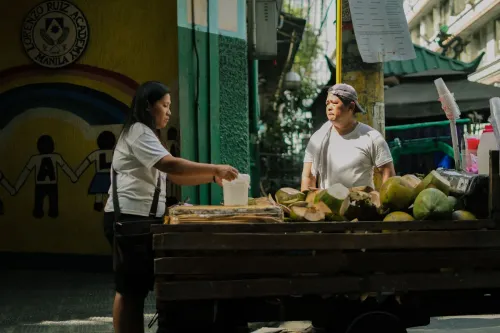
Magkano: How to Ask "How Much" in Tagalog
Magkano means how much in Tagalog. Learn to ask a price, tell it apart from ilan and gaano, sound polite with po, and haggle at the palengke.

Tagalog Verb Conjugation: Aspects Made Simple
Tagalog verb conjugation uses aspects, not tenses. Learn the three aspects with -um- and mag- verbs, one reduplication rule, and clear example tables.

Tagalog Numbers 1-100: Counting, Time & Money Explained
Learn Tagalog numbers 1-100 and beyond. Master both native and Spanish-derived counting systems, plus telling time, reading prices, and ordinals.