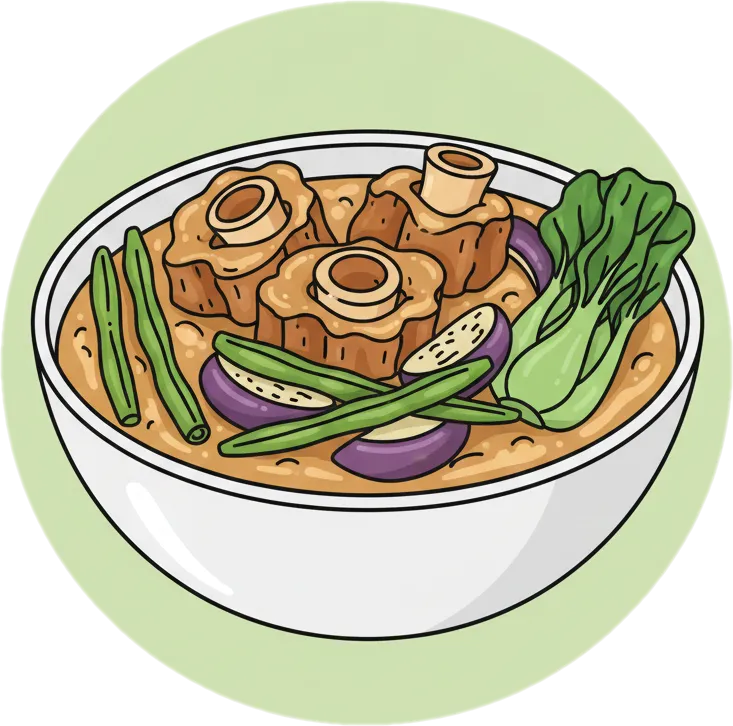
From root: kare-kare
Usage Note
Kinare-kare describes a dish where the main ingredient, such as seafood or vegetables, is prepared specifically in the style of the traditional peanut stew.
Examples
" Masarap ang kinare-kare. "
Natural Translation
The kare-kare is delicious.
Literal Translation
Delicious the cooked-in-peanut-sauce.
" Gusto ko ang kinare-kare na gulay. "
Natural Translation
I like the vegetables cooked in peanut sauce.
Literal Translation
Like I the cooked-in-peanut-sauce that vegetable.
" Tuwing may handaan sa bahay, ang kinare-kare na pata ang laging hinahanap ng aming mga bisita. "
Natural Translation
Whenever there is a feast at home, the pork hock cooked in peanut sauce is what our guests always look for.
Literal Translation
Every there-is feast at house, the cooked-in-peanut-sauce that hock the always sought by our guests.
Take Tagalog with you
The full course, a 12,500-word dictionary, and flashcards that make every word stick — free to start on iOS and Android.




Tagalog builds thousands of words from a few hundred roots.
How Tagalog words workWord family
kare-kare has 3 related forms built from the same root.
Related Words
Explore Tagalog by topic
Free guides on grammar, vocabulary, and culture to take you past single-word lookups.

May vs Mayroon vs Meron: Have & There Is
May vs mayroon in Tagalog finally made simple: one rule decides which to use, plus how meron and wala fit the same have and there-is family.

Philippines Geography for Learners: Islands & Language
Philippines geography for Tagalog learners: 7,641 islands, three island groups, and the Southern Luzon heartland where the Tagalog language was born.

Filipino Family Words and Honorifics: Ate, Kuya & Tita
Filipino family words like ate, kuya, tita, tito, lolo, and lola go far beyond family — learn how Filipinos use them with strangers, plus mano po etiquette.

Tagalog vs Filipino: What's the Difference & Which to Learn
Tagalog and Filipino aren't the same language — but they overlap almost completely. Here's the real difference and which one you should actually learn.