magkakarenderya
eatery owner or operator
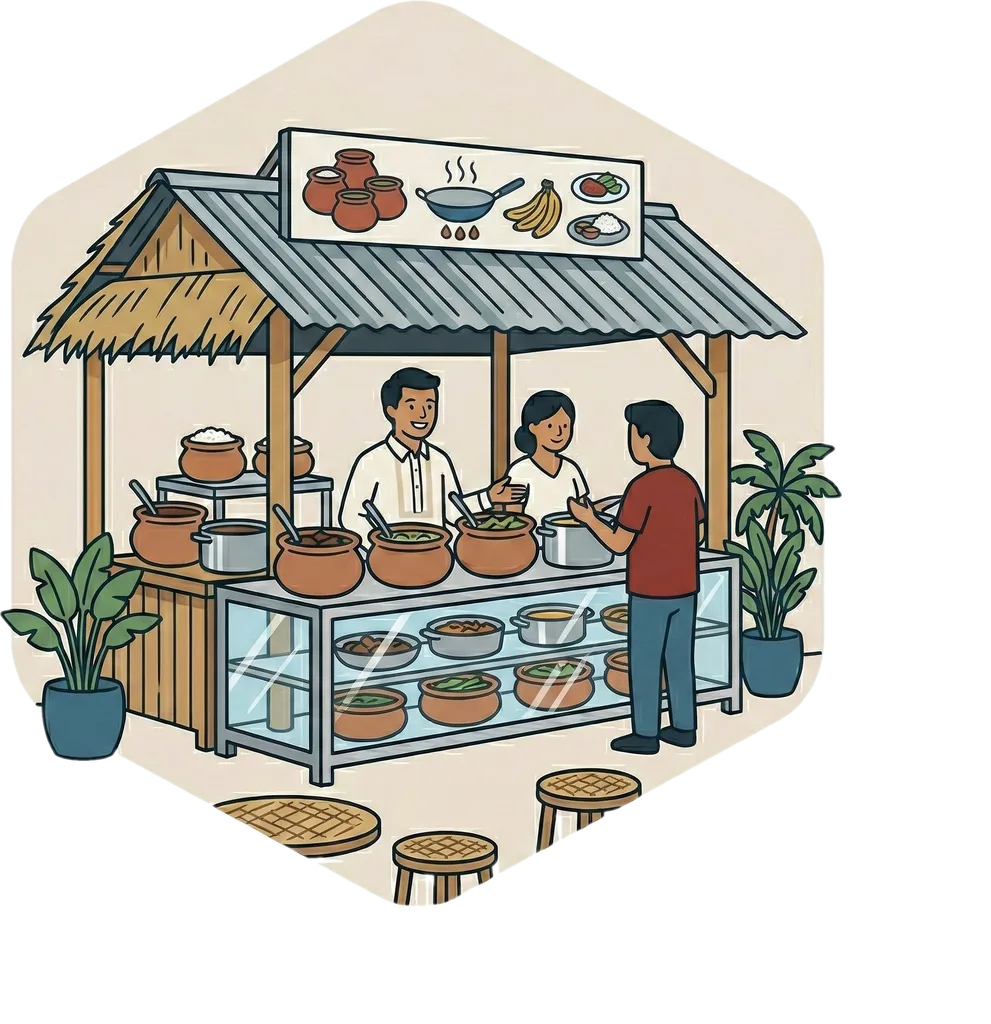
From root: karinderya
Usage Note
Magkakarenderya refers to the person who manages or owns the local food stall. It is a common source of livelihood for many Filipino families in local neighborhoods.
Examples
" Magkakarenderya ang nanay ko. "
Natural Translation
My mother is an eatery owner.
Literal Translation
Eatery-owner the mother my.
" Siya ay isang magkakarenderya. "
Natural Translation
He is an eatery operator.
Literal Translation
He/she is a eatery-operator.
" Bilang magkakarenderya, gumigising siya nang maaga para mamili sa palengke at maluto ang mga ulam bago dumating ang mga suki. "
Natural Translation
As an eatery owner, she wakes up early to shop at the market and cook the dishes before her regular customers arrive.
Literal Translation
As eatery-owner, waking she early to shop at market and to-cook the dishes before arrive the regular-customers.
Take Tagalog with you
The full course, a 12,500-word dictionary, and flashcards that make every word stick — free to start on iOS and Android.




Tagalog builds thousands of words from a few hundred roots.
How Tagalog words workWord family
karinderya has 3 related forms built from the same root.
Related Words
Explore Tagalog by topic
Free guides on grammar, vocabulary, and culture to take you past single-word lookups.

Is Tagalog Hard to Learn? An Honest Answer
Tagalog takes around 1,100 hours to reach professional proficiency. Here is what is easy, what is hard, and what to expect at 3, 6, and 12 months.

How Long Does It Take to Learn Tagalog?
Survival Tagalog takes ~3-4 weeks and comfortable conversation 6-12 months. FSI's 1,100 hours is the professional bar, not the talking-to-family bar.
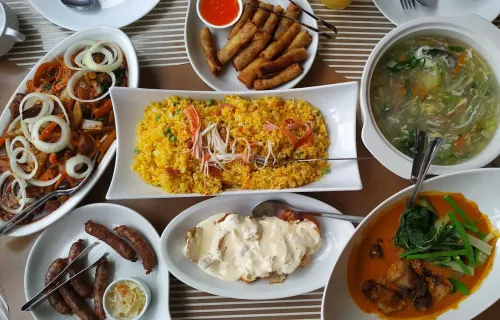
Filipino Food: 12 Essential Dishes (With Tagalog Names)
Filipino food, from adobo to halo-halo: learn the Tagalog names, pronunciations, and ingredients behind 12 dishes you'll want to try on your first trip.

Ng vs Nang in Tagalog: The Spelling Rule
Ng vs nang sound identical but spell differently. Use ng to mark nouns (of, the object), and nang for how, when, repetition, and counting time.