From root: kuha
Conjugations
Past (Completed)
nakuha
na-KU-ha
was able to get
Present (Incomplete)
naukuha
na-u-KU-ha
being able to get
Future (Contemplated)
makuha
ma-KU-ha
will be able to get
Usage Note
Makuha indicates the successful acquisition of something, often used in "Nakuha ko na" (I got it).
Examples
" Nakuha ko na ang sulat. "
Natural Translation
I already got the letter.
Literal Translation
Got I already the letter.
" Nakita ko siyang makuha ang susi. "
Natural Translation
I saw him be able to get the key.
Literal Translation
Saw I him be-able-to-get the key.
" Hindi ko makuha ang tamang sagot kahit ilang beses kong basahin ang tanong. "
Natural Translation
I can't get the right answer no matter how many times I read the question.
Literal Translation
Not I can-get the right answer even how-many times I read the question.
Take Tagalog with you
The full course, a 12,500-word dictionary, and flashcards that make every word stick — free to start on iOS and Android.




Tagalog builds thousands of words from a few hundred roots.
How Tagalog words workWord family
kuha has 8 related forms built from the same root.
Related Words
Explore Tagalog by topic
Free guides on grammar, vocabulary, and culture to take you past single-word lookups.

Mano Po and Filipino Etiquette: A Visitor's Guide
Mano po presses an elder's hand to your forehead as a blessing. Learn who to mano, how to lip-point, and the etiquette that wins over a Filipino family.

Filipino Family Words and Honorifics: Ate, Kuya & Tita
Filipino family words like ate, kuya, tita, tito, lolo, and lola go far beyond family — learn how Filipinos use them with strangers, plus mano po etiquette.

Is Tagalog Hard to Learn? An Honest Answer
Tagalog takes around 1,100 hours to reach professional proficiency. Here is what is easy, what is hard, and what to expect at 3, 6, and 12 months.
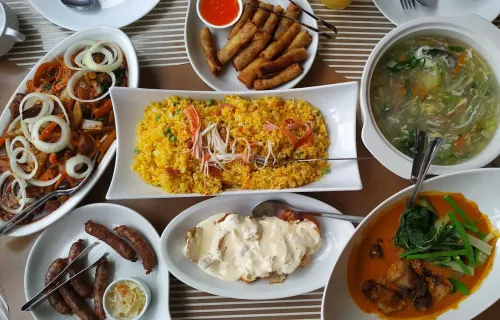
Filipino Food: 12 Essential Dishes (With Tagalog Names)
Filipino food, from adobo to halo-halo: learn the Tagalog names, pronunciations, and ingredients behind 12 dishes you'll want to try on your first trip.