panyo
panyô with stress marks
handkerchief

Usage Note
Panyo is a Spanish loanword (from paño, cloth) for handkerchief and remains an everyday essential in the Philippines — typically carried to wipe sweat during the humid heat or to cover the face from dust while commuting. It also appears in folk customs, such as the handkerchief dance pandanggo sa ilaw.
Examples
" May panyo ka ba? "
Natural Translation
Do you have a handkerchief?
Literal Translation
Have handkerchief you question?
" Ginamit ko ang panyo. "
Natural Translation
I used the handkerchief.
Literal Translation
Used I the handkerchief.
" Inilabas niya ang panyo sa kaniyang bulsa para punasan ang pawis sa kaniyang noo. "
Natural Translation
He took the handkerchief out of his pocket to wipe the sweat off his forehead.
Literal Translation
Took-out he the handkerchief from his pocket to wipe the sweat on his forehead.
Take Tagalog with you
The full course, a 12,500-word dictionary, and flashcards that make every word stick — free to start on iOS and Android.




Tagalog builds thousands of words from a few hundred roots.
How Tagalog words workDerived Words
Actor Focus Verbs
Object Focus Verbs
Related Words
Explore Tagalog by topic
Free guides on grammar, vocabulary, and culture to take you past single-word lookups.

Tagalog Pronouns Explained: Complete Chart with Examples
Every Tagalog pronoun explained with clear charts: ang/ng/sa forms, tayo vs kami, ikaw vs ka, politeness markers, and the mistakes beginners make.
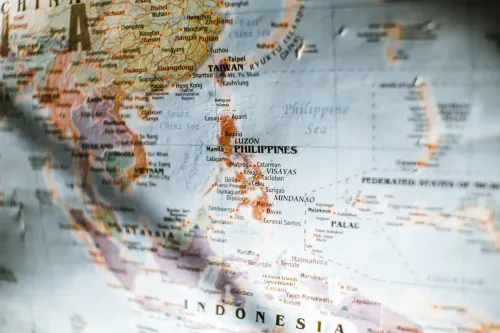
Philippines Geography for Learners: Islands & Language
Philippines geography for Tagalog learners: 7,641 islands, three island groups, and the Southern Luzon heartland where the Tagalog language was born.

How Long Does It Take to Learn Tagalog?
Survival Tagalog takes ~3-4 weeks and comfortable conversation 6-12 months. FSI's 1,100 hours is the professional bar, not the talking-to-family bar.

Tagalog Numbers 1-100: Counting, Time & Money Explained
Learn Tagalog numbers 1-100 and beyond. Master both native and Spanish-derived counting systems, plus telling time, reading prices, and ordinals.