rasa
rása with stress marks
race; breed; ancestry
Usage Note
Rasa comes from Spanish 'raza' and is used to describe racial or ethnic background, the breed of an animal, or lineage. In everyday speech it is most often heard when discussing dogs' breeds or when commenting on mixed heritage, particularly in the context of mestizo identity in the Philippines.
Examples
" Anong rasa ng pusa mo? "
Natural Translation
What breed is your cat?
Literal Translation
What breed of cat your?
" Anong rasa ng iyong aso? "
Natural Translation
What breed is your dog?
Literal Translation
What breed of your dog?
" Iba't ibang rasa ng mga hayop ang ipinakita sa eksibisyon, mula sa mga aso hanggang sa mga manok. "
Natural Translation
Different breeds of animals were shown at the exhibition, from dogs to chickens.
Literal Translation
Various breeds of the animals the shown at exhibition, from the dogs until to the chickens.
Take Tagalog with you
The full course, a 12,500-word dictionary, and flashcards that make every word stick — free to start on iOS and Android.




Tagalog builds thousands of words from a few hundred roots.
How Tagalog words workRelated Words
- AWOL absence without leave
- Amboy short for American boy
- Ati ethnolinguistic group in Panay
- Balbalan ethnolinguistic group (Kalinga)
- Hiligaynon ethnolinguistic group/language
- Ilokana female native of the Ilocos region; Ilokana woman
- Ilokano Ethnolinguistic group in Ilocos
- Ilonggo Language/People of Western Visayas
Explore Tagalog by topic
Free guides on grammar, vocabulary, and culture to take you past single-word lookups.

Ng vs Nang in Tagalog: The Spelling Rule
Ng vs nang sound identical but spell differently. Use ng to mark nouns (of, the object), and nang for how, when, repetition, and counting time.
May vs Mayroon vs Meron: Have & There Is
May vs mayroon in Tagalog finally made simple: one rule decides which to use, plus how meron and wala fit the same have and there-is family.

Mano Po and Filipino Etiquette: A Visitor's Guide
Mano po presses an elder's hand to your forehead as a blessing. Learn who to mano, how to lip-point, and the etiquette that wins over a Filipino family.
Philippines Geography for Learners: Islands & Language
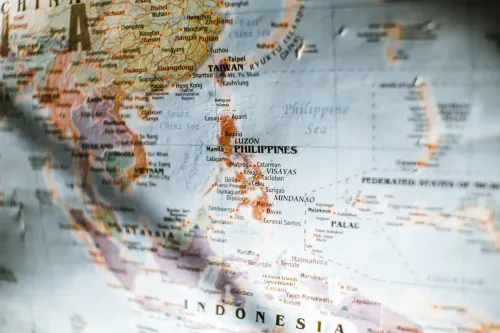
Philippines geography for Tagalog learners: 7,641 islands, three island groups, and the Southern Luzon heartland where the Tagalog language was born.