salba
salbâ with stress marks
to rescue or save
Usage Note
Salba is borrowed from Spanish salvar and is used colloquially for saving or rescuing someone from danger, failure, or embarrassment. It is more informal than the native iligtas and appears often in casual expressions of relief after a close call.
Examples
" Sinalba niya ang aso. "
Natural Translation
He rescued the dog.
Literal Translation
Rescued he the dog.
" Kailangan natin ng salba mula sa baha ngayon. "
Natural Translation
We need a rescue from the flood right now.
Literal Translation
Need we of rescue from at-the flood now.
" Kung hindi mo ako sinalba sa huling minuto, baka bumagsak na ako sa pagsusulit kahapon. "
Natural Translation
If you hadn't saved me at the last minute, I might have failed yesterday's exam.
Literal Translation
If not you me rescued at last minute, maybe fail already I in exam yesterday.
Take Tagalog with you
The full course, a 12,500-word dictionary, and flashcards that make every word stick — free to start on iOS and Android.




Tagalog builds thousands of words from a few hundred roots.
How Tagalog words workActor Focus Verbs
Object Focus Verbs
Related Words
- AWOL absence without leave
- Amboy short for American boy
- Ati ethnolinguistic group in Panay
- Balbalan ethnolinguistic group (Kalinga)
- Hiligaynon ethnolinguistic group/language
- Ilokana female native of the Ilocos region; Ilokana woman
- Ilokano Ethnolinguistic group in Ilocos
- Ilonggo Language/People of Western Visayas
Explore Tagalog by topic
Free guides on grammar, vocabulary, and culture to take you past single-word lookups.

May vs Mayroon vs Meron: Have & There Is
May vs mayroon in Tagalog finally made simple: one rule decides which to use, plus how meron and wala fit the same have and there-is family.

Tagalog vs Filipino: What's the Difference & Which to Learn
Tagalog and Filipino aren't the same language — but they overlap almost completely. Here's the real difference and which one you should actually learn.

Tagalog Word Order: Sentence Structure Made Simple
Why Tagalog puts the verb first, and how ang, ng, and sa markers work. A clear guide to VSO word order, forming questions, and negation.
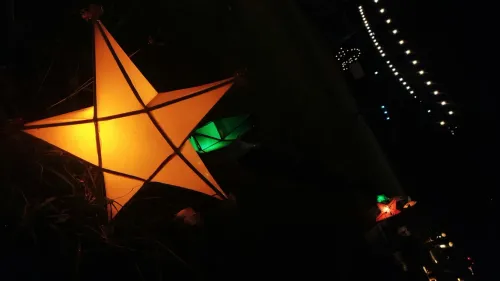
Philippine Christmas Traditions: World's Longest Holiday
Philippine Christmas traditions run four months — from Ber-month carols to Simbang Gabi dawn masses, Noche Buena feasts, and parol lanterns lighting every street.