sampagita
sampagíta with stress marks
Arabian jasmine; national flower of the Philippines
Usage Note
Sampagita (Jasminum sambac) is the national flower of the Philippines, declared so in 1934. Its small white star-shaped blooms and intensely sweet fragrance make it central to religious offerings, traditional garlands ('lei'), and perfume. Street vendors selling sampagita garlands are a common and culturally resonant sight.
Examples
" Mabango ang sampagita. "
Natural Translation
The sampaguita is fragrant.
Literal Translation
Fragrant the sampaguita.
" Bumili siya ng sampagita. "
Natural Translation
He/She bought sampagita.
Literal Translation
Bought he/she of sampagita.
" Tuwing Linggo, may batang nagtitinda ng sampagita sa labas ng simbahan para may pambili ng pagkain. "
Natural Translation
Every Sunday, there is a child selling sampaguita outside the church to have money for food.
Literal Translation
Every Sunday, there-is child selling of sampaguita at outside of church so-that have money-to-buy of food.
Take Tagalog with you
The full course, a 12,500-word dictionary, and flashcards that make every word stick — free to start on iOS and Android.




Tagalog builds thousands of words from a few hundred roots.
How Tagalog words workRelated Words
Explore Tagalog by topic
Free guides on grammar, vocabulary, and culture to take you past single-word lookups.

Tagalog Time Expressions: Past, Present & Future Guide
Tagalog has no tenses — it uses aspect. Learn time words, days of the week, clock time, and the aspect system, with vocabulary tables and cultural notes.
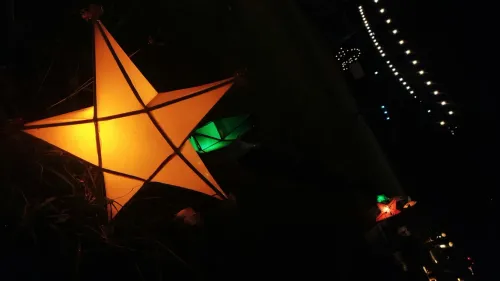
Philippine Christmas Traditions: World's Longest Holiday
Philippine Christmas traditions run four months — from Ber-month carols to Simbang Gabi dawn masses, Noche Buena feasts, and parol lanterns lighting every street.
Tagalog Numbers 1-100: Counting, Time & Money Explained
Learn Tagalog numbers 1-100 and beyond. Master both native and Spanish-derived counting systems, plus telling time, reading prices, and ordinals.

How to Say "I Love You" in Tagalog: Phrases & Meaning
Learn how to say I love you in Tagalog. Mahal kita, Iniibig kita, and Filipino terms of endearment for partners, family, and friends — with cultural notes.