santo
sánto with stress marks
male saint
Usage Note
Santo is the Spanish-derived title for a canonized male saint and is woven throughout Philippine Catholic life — in town names, street signs, church fiestas, and daily devotion. It is used respectfully in both religious and secular contexts. The feminine counterpart is santa.
Examples
" Mabait na santo siya. "
Natural Translation
He is a kind saint.
Literal Translation
Kind saint he.
" Gusto ng bata na tularan ang isang santo sa kanyang kabaitan. "
Natural Translation
The child wants to imitate a male saint in his kindness.
Literal Translation
Want of child to imitate the a male saint in his/her kindness.
" Tuwing pista ng aming bayan, idinaraos ang prusisyon kung saan pinaparada ang imahe ng santo sa mga lansangan. "
Natural Translation
During our town's fiesta, a procession is held where the image of the saint is paraded through the streets.
Literal Translation
Every fiesta of our town, is-held the procession where is-paraded the image of saint in the streets.
Take Tagalog with you
The full course, a 12,500-word dictionary, and flashcards that make every word stick — free to start on iOS and Android.




Tagalog builds thousands of words from a few hundred roots.
How Tagalog words workRelated Words
Explore Tagalog by topic
Free guides on grammar, vocabulary, and culture to take you past single-word lookups.
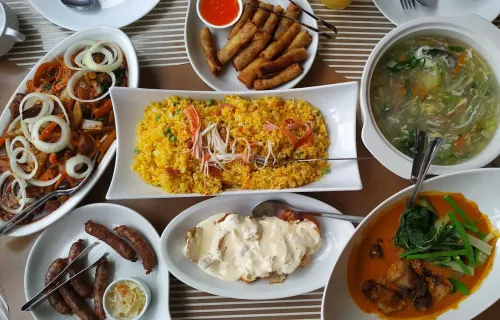
Filipino Food: 12 Essential Dishes (With Tagalog Names)
Filipino food, from adobo to halo-halo: learn the Tagalog names, pronunciations, and ingredients behind 12 dishes you'll want to try on your first trip.

Days of the Week and Months in Tagalog
The days of the week and months in Tagalog are Spanish loanwords. Learn all 7 days and 12 months with pronunciation, plus how to say dates and 'every Monday.'

Tagalog Slang Guide: 20 Words You'll Hear on TikTok
Tagalog slang explained: lodi, petmalu, werpa, astig, chika and more. Decode Filipino TikTok comments, group chats, and pop culture with this practical guide.

Tagalog Word Order: Sentence Structure Made Simple
Why Tagalog puts the verb first, and how ang, ng, and sa markers work. A clear guide to VSO word order, forming questions, and negation.