magtagtag
magtagtág with stress marks
to shake or jolt
From root: tagtag
Conjugations
Past (Completed)
nagtagtag
nag-tag-TAG
shook
Present (Incomplete)
nagtatagtag
nag-ta-tag-TAG
is shaking
Future (Contemplated)
magtatagtag
mag-ta-tag-TAG
will shake
Usage Note
Magtagtag is the actor-focus form of the reduplicated root tagtag, used for shaking something loose or causing jolts. It is common for shaking dust out of mats, banigs, or rugs, and the reduplication evokes the repeated back-and-forth motion of the action.
Examples
" Magtagtag ka ng banig. "
Natural Translation
Shake out the mat.
Literal Translation
Shake you of mat.
" Delikadong magtagtag ang traysikel sa baku-bakong daan para sa buntis. "
Natural Translation
It is dangerous for a tricycle to jolt on bumpy roads for a pregnant woman.
Literal Translation
Dangerous to jolt the tricycle on bumpy street for to pregnant.
" Bago tiklupin ang mga banig, nagtagtag muna kami sa labas ng bahay upang matanggal ang alikabok at mga tuyong dahon. "
Natural Translation
Before folding the mats, we first shook them out outside the house to remove the dust and the dry leaves.
Literal Translation
Before to-fold the mats, shook first we outside of house so-that removed the dust and dry leaves.
Take Tagalog with you
The full course, a 12,500-word dictionary, and flashcards that make every word stick — free to start on iOS and Android.




Tagalog builds thousands of words from a few hundred roots.
How Tagalog words workWord family
tagtag has 1 related form built from the same root.
Related Words
Explore Tagalog by topic
Free guides on grammar, vocabulary, and culture to take you past single-word lookups.

Ng vs Nang in Tagalog: The Spelling Rule
Ng vs nang sound identical but spell differently. Use ng to mark nouns (of, the object), and nang for how, when, repetition, and counting time.

Tagalog Word Order: Sentence Structure Made Simple
Why Tagalog puts the verb first, and how ang, ng, and sa markers work. A clear guide to VSO word order, forming questions, and negation.

Filipino Family Words and Honorifics: Ate, Kuya & Tita
Filipino family words like ate, kuya, tita, tito, lolo, and lola go far beyond family — learn how Filipinos use them with strangers, plus mano po etiquette.
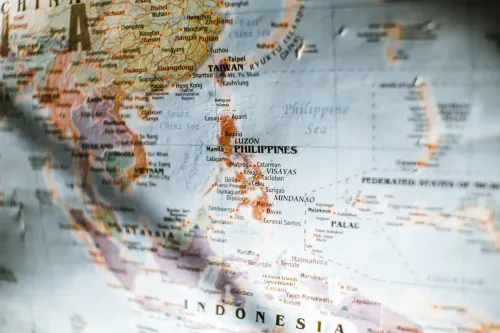
Philippines Geography for Learners: Islands & Language
Philippines geography for Tagalog learners: 7,641 islands, three island groups, and the Southern Luzon heartland where the Tagalog language was born.