tumalima
tumalimâ with stress marks
to comply
From root: talima
Conjugations
Past (Completed)
tumalima
tu-ma-li-MA
complied
Present (Incomplete)
tumatalima
tu-ma-ta-li-MA
is complying
Future (Contemplated)
tatalima
ta-ta-li-MA
will comply
Usage Note
Tumalima is the actor-focus form of talima, implying willing, respectful compliance with an authority or directive. It has a more elevated and literary register than ordinary obedience words, and appears most naturally in religious, formal, or philosophical contexts where submission to a higher will is being expressed.
Examples
" Tumalima siya sa utos ng ama. "
Natural Translation
He obeyed his father's command.
Literal Translation
Complied he with command of father.
" Handa siyang tumalima sa lahat ng utos ng pinuno. "
Natural Translation
He/She is ready to comply with all the leader's commands.
Literal Translation
Ready he/she to-comply with all of commands of leader.
" Mahirap mang gawin, nagpasya pa rin siyang tumalima sa kalooban ng Diyos sa kabila ng kanyang pag-aalinlangan. "
Natural Translation
Though it was hard to do, he still decided to comply with God's will despite his doubts.
Literal Translation
Hard although do, decided still he to-comply with will of God despite of his doubts.
Take Tagalog with you
The full course, a 12,500-word dictionary, and flashcards that make every word stick — free to start on iOS and Android.




Tagalog builds thousands of words from a few hundred roots.
How Tagalog words workRelated Words
Explore Tagalog by topic
Free guides on grammar, vocabulary, and culture to take you past single-word lookups.
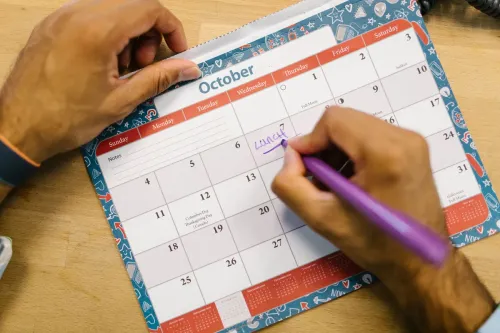
Days of the Week and Months in Tagalog
The days of the week and months in Tagalog are Spanish loanwords. Learn all 7 days and 12 months with pronunciation, plus how to say dates and 'every Monday.'

Filipino Food: 12 Essential Dishes (With Tagalog Names)
Filipino food, from adobo to halo-halo: learn the Tagalog names, pronunciations, and ingredients behind 12 dishes you'll want to try on your first trip.

How to Say "I Love You" in Tagalog: Phrases & Meaning
Learn how to say I love you in Tagalog. Mahal kita, Iniibig kita, and Filipino terms of endearment for partners, family, and friends — with cultural notes.

Ng vs Nang in Tagalog: The Spelling Rule
Ng vs nang sound identical but spell differently. Use ng to mark nouns (of, the object), and nang for how, when, repetition, and counting time.