tapos
tapós with stress marks
finished; end; graduated
Usage Note
Tapos is used to signal that a task is finished, often paired with the particle 'na' (Tapos na) to mean 'it's already done.' In daily conversation, it also serves as a common transition word meaning 'and then' when telling stories or sequencing events.
Examples
" Tapos na ang klase. "
Natural Translation
The class is over.
Literal Translation
Finished already the class.
" Tapos na ako kumain. "
Natural Translation
I am finished eating.
Literal Translation
Finished already I eat.
" Naghanda muna kami ng hapunan, tapos nanood kami ng pelikula bago matulog ang mga bata. "
Natural Translation
We first prepared dinner, and then we watched a movie before the children went to sleep.
Literal Translation
Prepared first we of dinner, then watched we of movie before sleep the plural child.
Take Tagalog with you
The full course, a 12,500-word dictionary, and flashcards that make every word stick — free to start on iOS and Android.




Tagalog builds thousands of words from a few hundred roots.
How Tagalog words workDerived Words
Actor Focus Verbs
Object Focus Verbs
Related Words
Explore Tagalog by topic
Free guides on grammar, vocabulary, and culture to take you past single-word lookups.
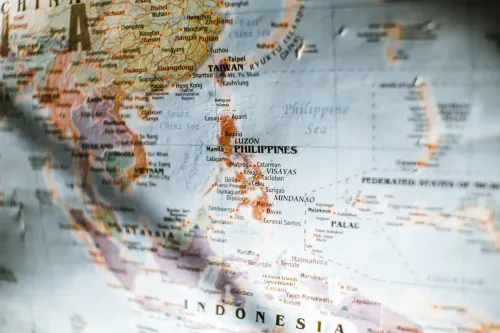
Philippines Geography for Learners: Islands & Language
Philippines geography for Tagalog learners: 7,641 islands, three island groups, and the Southern Luzon heartland where the Tagalog language was born.

Tagalog Root Words: Learn a Few Hundred, Understand Thousands
Tagalog root words unlock vocabulary fast: learn a few hundred and recognize thousands. Real word families, examples, and a practical study strategy.

Mano Po and Filipino Etiquette: A Visitor's Guide
Mano po presses an elder's hand to your forehead as a blessing. Learn who to mano, how to lip-point, and the etiquette that wins over a Filipino family.

Ng vs Nang in Tagalog: The Spelling Rule
Ng vs nang sound identical but spell differently. Use ng to mark nouns (of, the object), and nang for how, when, repetition, and counting time.