uban
ubán with stress marks
white hair; gray hair
Usage Note
Uban refers specifically to white or gray hair that appears with aging, stress, or genetics. In Filipino culture, uban is often associated with wisdom and old age, and pulling out uban hairs is considered a folk remedy that paradoxically leads to more growing back. Younger people who develop uban early are sometimes said to have worried too much.
Examples
" May uban na ang tatay ko. "
Natural Translation
My dad already has gray hair.
Literal Translation
Has gray-hair already the father my.
" Marami na siyang uban kahit bata pa siya. "
Natural Translation
He/She already has a lot of gray hair even though he/she's still young.
Literal Translation
Many already his/her gray-hair even-though young still he/she.
" Maaga siyang nagkaroon ng uban dahil sa labis na pag-aalala sa trabaho at sa kalusugan ng kanyang pamilya. "
Natural Translation
He developed gray hair early because of excessive worrying about work and his family's health.
Literal Translation
Early he had of gray-hair because of excessive worry at work and at health of his family.
Take Tagalog with you
The full course, a 12,500-word dictionary, and flashcards that make every word stick — free to start on iOS and Android.




Tagalog builds thousands of words from a few hundred roots.
How Tagalog words workRelated Words
Explore Tagalog by topic
Free guides on grammar, vocabulary, and culture to take you past single-word lookups.

Filipino Family Words and Honorifics: Ate, Kuya & Tita
Filipino family words like ate, kuya, tita, tito, lolo, and lola go far beyond family — learn how Filipinos use them with strangers, plus mano po etiquette.

Tagalog Word Order: Sentence Structure Made Simple
Why Tagalog puts the verb first, and how ang, ng, and sa markers work. A clear guide to VSO word order, forming questions, and negation.
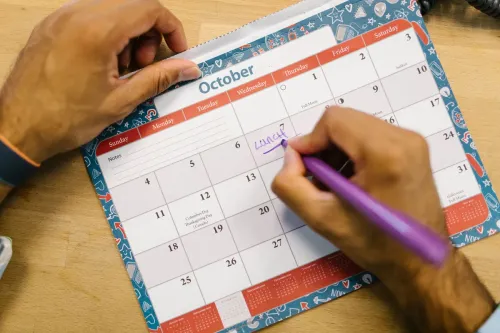
Days of the Week and Months in Tagalog
The days of the week and months in Tagalog are Spanish loanwords. Learn all 7 days and 12 months with pronunciation, plus how to say dates and 'every Monday.'

Tagalog Time Expressions: Past, Present & Future Guide
Tagalog has no tenses — it uses aspect. Learn time words, days of the week, clock time, and the aspect system, with vocabulary tables and cultural notes.