mag-umpisa
mag-umpísa with stress marks
to start; to begin
From root: umpisa
Conjugations
Past (Completed)
nag-umpisa
nag-um-PI-sa
started
Present (Incomplete)
nag-uumpisa
nag-u-um-PI-sa
is starting
Future (Contemplated)
mag-uumpisa
mag-u-um-PI-sa
will start
Usage Note
Mag-umpisa is the actor-focus form of umpisa, a Spanish loanword from empezar via empezar's noun form. It is the everyday verb for beginning any activity and is slightly more informal than magsimula, making it the natural choice in casual conversation and colloquial speech.
Examples
" Mag-umpisa na tayo. "
Natural Translation
Let's start now.
Literal Translation
Start now we.
" Mas magandang mag-umpisa nang maaga para matapos agad ang gawain. "
Natural Translation
It is better to start early so the task finishes immediately.
Literal Translation
More good to-start , early so to-finish immediately the task.
" Bago kami mag-umpisa ng pagluluto, sinigurado muna naming kompleto ang lahat ng sangkap sa mesa. "
Natural Translation
Before we started cooking, we first made sure all the ingredients were complete on the table.
Literal Translation
Before we start of cooking, made-sure first we complete the all of ingredients on table.
Take Tagalog with you
The full course, a 12,500-word dictionary, and flashcards that make every word stick — free to start on iOS and Android.




Tagalog builds thousands of words from a few hundred roots.
How Tagalog words workWord family
umpisa has 1 related form built from the same root.
Related Words
Explore Tagalog by topic
Free guides on grammar, vocabulary, and culture to take you past single-word lookups.
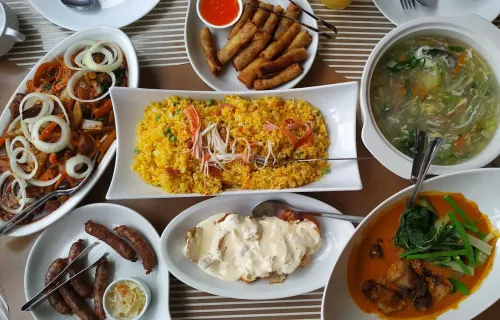
Filipino Food: 12 Essential Dishes (With Tagalog Names)
Filipino food, from adobo to halo-halo: learn the Tagalog names, pronunciations, and ingredients behind 12 dishes you'll want to try on your first trip.

Ang, Ng, Sa: The 3 Tagalog Case Markers Explained
Ang, ng, sa are the three Tagalog case markers every noun takes. Learn what each does, the personal forms si/ni/kay, plurals with mga, and clear examples.

Tagalog Affixes Explained: A Beginner's Guide to Word Building
Tagalog affixes turn one root word into dozens of meanings. Learn prefixes, infixes, suffixes, and circumfixes with clear examples for beginners.
Spaced Repetition for Tagalog: How Flashcards Make Words Stick
Cramming Tagalog vocabulary fails. See how spaced repetition — the science behind smart flashcards — makes words stick for the long term.