umpisa
umpísa with stress marks
start or beginning
Usage Note
Umpisa is one of the most common words for 'start' in everyday Tagalog, borrowed from Spanish 'empezar', and is used as both a noun and a verb. It sits alongside the more formal 'simula' and is neutral in register, fitting casual and semi-formal contexts equally well.
Examples
" Magsimula na tayo sa umpisa. "
Natural Translation
Let's begin at the start.
Literal Translation
Let-us-begin already we at-the start.
" Ito ang umpisa ng klase ngayon. "
Natural Translation
This is the start of the class today.
Literal Translation
This the start of class today.
" Mahirap man sa umpisa ang pag-aaral ng wika, unti-unti itong gumagaan kapag araw-araw kang nagsasanay. "
Natural Translation
Although learning a language is hard at the start, it gradually gets easier when you practice every day.
Literal Translation
Hard though at-the start the learning of language, little-by-little it getting-light when day-by-day you practicing.
Take Tagalog with you
The full course, a 12,500-word dictionary, and flashcards that make every word stick — free to start on iOS and Android.




Tagalog builds thousands of words from a few hundred roots.
How Tagalog words workActor Focus Verbs
Object Focus Verbs
Related Words
Explore Tagalog by topic
Free guides on grammar, vocabulary, and culture to take you past single-word lookups.
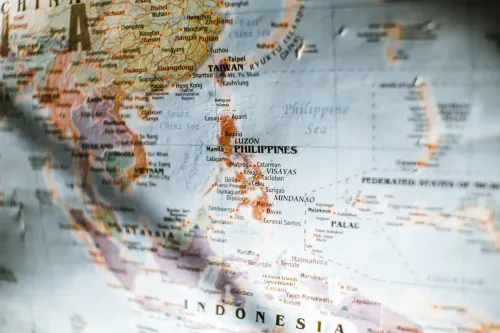
Philippines Geography for Learners: Islands & Language
Philippines geography for Tagalog learners: 7,641 islands, three island groups, and the Southern Luzon heartland where the Tagalog language was born.

Tagalog Word Order: Sentence Structure Made Simple
Why Tagalog puts the verb first, and how ang, ng, and sa markers work. A clear guide to VSO word order, forming questions, and negation.

Mano Po and Filipino Etiquette: A Visitor's Guide
Mano po presses an elder's hand to your forehead as a blessing. Learn who to mano, how to lip-point, and the etiquette that wins over a Filipino family.

Seasons in the Philippines: A Tagalog Guide
The Philippines has two seasons, not four. Learn tag-araw, tag-ulan, and taglamig, the generative tag- prefix, and the weather vocabulary to match.