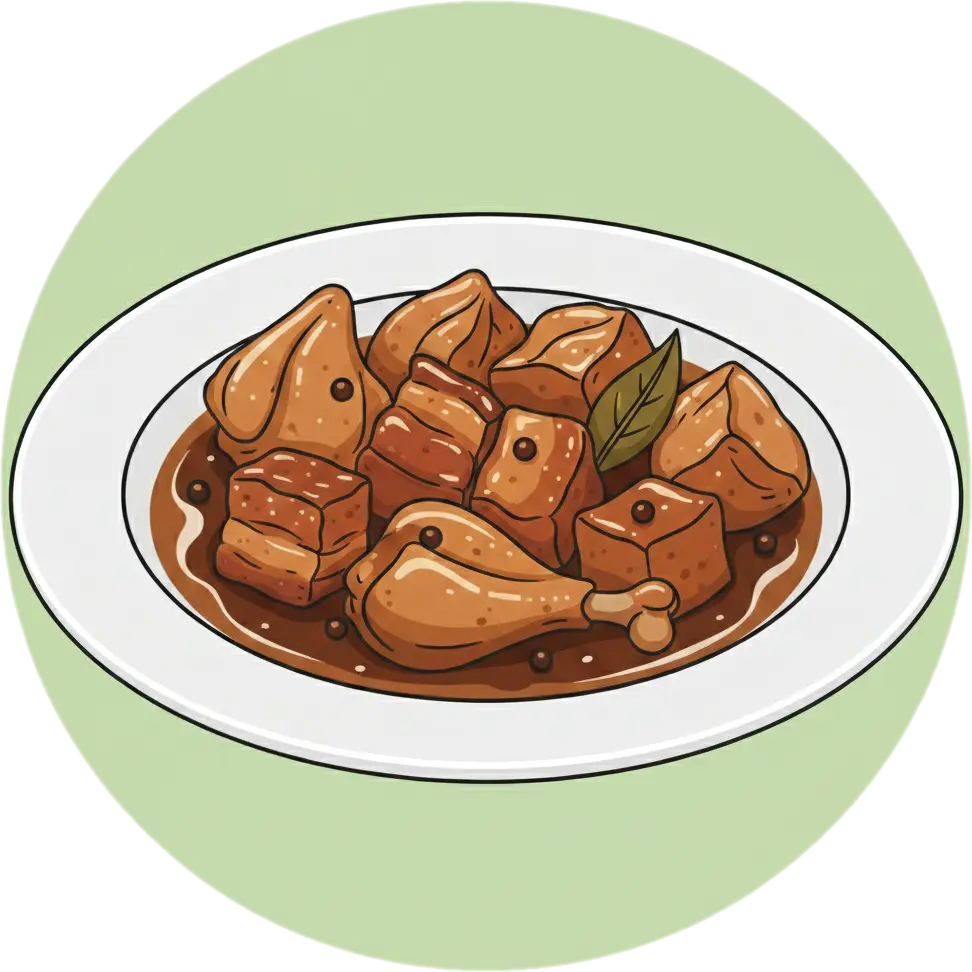
From root: adobo
Conjugations
Past (Completed)
inadobo
i-na-DO-bo
cooked as adobo
Present (Incomplete)
inaadobo
i-na-a-DO-bo
cooking as adobo
Future (Contemplated)
aadobohin
a-a-do-bo-HIN
will cook as adobo
Usage Note
Adobohin is used when specifying a particular ingredient to be prepared in the traditional adobo style, focusing on the meat or vegetable being marinated and simmered in vinegar and soy sauce. It is a common object-focus verb used in culinary contexts and daily meal planning.
Examples
" Adobohin natin ang baboy. "
Natural Translation
Let's cook the pork as adobo.
Literal Translation
Cook-as-adobo we the pork.
" Gusto niyang adobohin ang manok. "
Natural Translation
She wants to cook the chicken as adobo.
Literal Translation
Want she cook-as-adobo the chicken.
" Kapag wala kaming maisip na ulam, madalas naming adobohin ang manok dahil paborito iyon ng buong pamilya. "
Natural Translation
When we can't think of a dish, we often cook the chicken as adobo because that's the whole family's favorite.
Literal Translation
When none we can-think of dish, often by-us cook-as-adobo the chicken because favorite that of whole family.
Take Tagalog with you
The full course, a 12,500-word dictionary, and flashcards that make every word stick — free to start on iOS and Android.




Tagalog builds thousands of words from a few hundred roots.
How Tagalog words workWord family
adobo has 3 related forms built from the same root.
Related Words
Explore Tagalog by topic
Free guides on grammar, vocabulary, and culture to take you past single-word lookups.

Ang, Ng, Sa: The 3 Tagalog Case Markers Explained
Ang, ng, sa are the three Tagalog case markers every noun takes. Learn what each does, the personal forms si/ni/kay, plurals with mga, and clear examples.

Days of the Week and Months in Tagalog
The days of the week and months in Tagalog are Spanish loanwords. Learn all 7 days and 12 months with pronunciation, plus how to say dates and 'every Monday.'

Philippine Christmas Traditions: World's Longest Holiday
Philippine Christmas traditions run four months — from Ber-month carols to Simbang Gabi dawn masses, Noche Buena feasts, and parol lanterns lighting every street.

Ng vs Nang in Tagalog: The Spelling Rule
Ng vs nang sound identical but spell differently. Use ng to mark nouns (of, the object), and nang for how, when, repetition, and counting time.