From root: bait
Conjugations
Past (Completed)
bumait
bu-ma-IT
became good
Present (Incomplete)
bumabait
bu-ma-ba-IT
becoming good
Future (Contemplated)
babait
ba-ba-IT
will become good
Usage Note
Bumait is used to describe a change in behavior where someone becomes more well-behaved, obedient, or kind, often after a period of being naughty or difficult. It is frequently heard in parental contexts or when observing a positive shift in a person's character.
Examples
" Bumait na ang bata. "
Natural Translation
The child has become well-behaved.
Literal Translation
Became-good now the child.
" Sana ay bumait ang batang iyon. "
Natural Translation
I hope that child becomes good.
Literal Translation
Hope is become-good the child that.
" Nangako siyang babait kapag binilhan namin siya ng laruan, pero pansamantala lamang ang pagbabago niya. "
Natural Translation
He promised he would behave if we bought him a toy, but his change was only temporary.
Literal Translation
Promised he will-become-good when buy we him of toy, but temporary only the change his.
Take Tagalog with you
The full course, a 12,500-word dictionary, and flashcards that make every word stick — free to start on iOS and Android.




Tagalog builds thousands of words from a few hundred roots.
How Tagalog words workWord family
bait has 6 related forms built from the same root.
Related Words
Explore Tagalog by topic
Free guides on grammar, vocabulary, and culture to take you past single-word lookups.
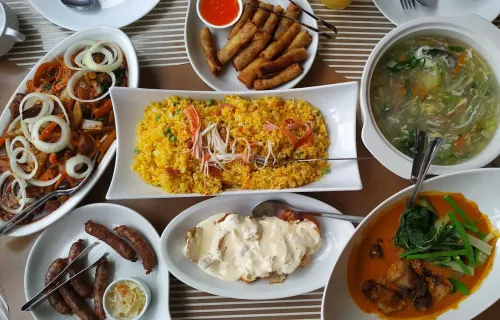
Filipino Food: 12 Essential Dishes (With Tagalog Names)
Filipino food, from adobo to halo-halo: learn the Tagalog names, pronunciations, and ingredients behind 12 dishes you'll want to try on your first trip.

Mano Po and Filipino Etiquette: A Visitor's Guide
Mano po presses an elder's hand to your forehead as a blessing. Learn who to mano, how to lip-point, and the etiquette that wins over a Filipino family.

Seasons in the Philippines: A Tagalog Guide
The Philippines has two seasons, not four. Learn tag-araw, tag-ulan, and taglamig, the generative tag- prefix, and the weather vocabulary to match.

Filipino Family Words and Honorifics: Ate, Kuya & Tita
Filipino family words like ate, kuya, tita, tito, lolo, and lola go far beyond family — learn how Filipinos use them with strangers, plus mano po etiquette.