magbigwas
magbigwás with stress marks
to strike sharply
From root: bigwas
Conjugations
Past (Completed)
nagbigwas
nag-big-WAS
struck
Present (Incomplete)
nagbibigwas
nag-bi-big-WAS
is striking
Future (Contemplated)
magbibigwas
mag-bi-big-WAS
will strike
Usage Note
Magbigwas is the actor-focus infinitive of bigwas, emphasizing the person delivering a sharp, forceful strike or swing. Common in martial arts, action narratives, and combat descriptions, the word conveys a decisive single blow rather than sustained fighting. Its object-focus counterpart bigwasan targets the recipient of the blow.
Examples
" Marunong siyang magbigwas. "
Natural Translation
He knows how to strike sharply.
Literal Translation
Knows-how he to-strike-sharply.
" Mahirap magbigwas kapag walang lakas. "
Natural Translation
It is hard to strike sharply when there is no strength.
Literal Translation
Hard to strike sharply when no strength.
" Sa eksena ng pelikula, kailangang magbigwas nang mabilis ang bida bago pa siya tamaan ng kalaban. "
Natural Translation
In the film scene, the hero must strike sharply and quickly before the enemy can hit him.
Literal Translation
In scene of film, need to-strike-sharply quickly the hero before still he be-hit by enemy.
Take Tagalog with you
The full course, a 12,500-word dictionary, and flashcards that make every word stick — free to start on iOS and Android.




Tagalog builds thousands of words from a few hundred roots.
How Tagalog words workWord family
bigwas has 1 related form built from the same root.
Related Words
Explore Tagalog by topic
Free guides on grammar, vocabulary, and culture to take you past single-word lookups.
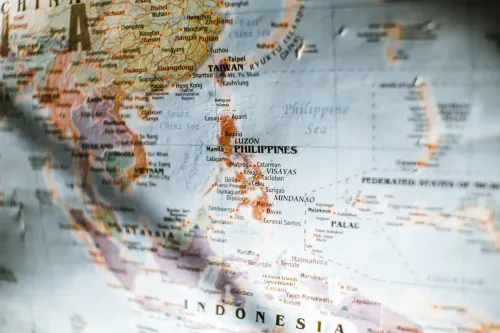
Philippines Geography for Learners: Islands & Language
Philippines geography for Tagalog learners: 7,641 islands, three island groups, and the Southern Luzon heartland where the Tagalog language was born.

How to Say "I Love You" in Tagalog: Phrases & Meaning
Learn how to say I love you in Tagalog. Mahal kita, Iniibig kita, and Filipino terms of endearment for partners, family, and friends — with cultural notes.

Is Tagalog Hard to Learn? An Honest Answer
Tagalog takes around 1,100 hours to reach professional proficiency. Here is what is easy, what is hard, and what to expect at 3, 6, and 12 months.

Filipino Family Words and Honorifics: Ate, Kuya & Tita
Filipino family words like ate, kuya, tita, tito, lolo, and lola go far beyond family — learn how Filipinos use them with strangers, plus mano po etiquette.