dulo
dúlo with stress marks
end; result; conclusion
Usage Note
Dulo is a highly versatile word meaning both the physical end of something — the tip of a stick, the end of a road — and the conclusion or outcome of a process. The phrase sa dulo is a natural discourse marker in storytelling, equivalent to 'in the end' or 'finally.'
Examples
" Nasa dulo ng kalye ang bahay. "
Natural Translation
The house is at the end of the street.
Literal Translation
At-the end of street the house.
" Sa dulo ng kuwento, nagtagumpay ang bida. "
Natural Translation
At the end of the story, the hero succeeded.
Literal Translation
At-the end of-the story, succeeded the hero.
" Sa dulo ng mahabang pagsubok, natanto niyang ang tunay na tagumpay ay ang hindi pagsuko sa gitna ng hirap. "
Natural Translation
In the end of the long ordeal, he realized that true success is not giving up in the midst of hardship.
Literal Translation
At-the end of long trial, realized he the true success is the not giving-up in middle of hardship.
Take Tagalog with you
The full course, a 12,500-word dictionary, and flashcards that make every word stick — free to start on iOS and Android.




Tagalog builds thousands of words from a few hundred roots.
How Tagalog words workRelated Words
Explore Tagalog by topic
Free guides on grammar, vocabulary, and culture to take you past single-word lookups.

Tagalog Question Words: Ano, Sino, Saan & More
Tagalog question words like ano, sino, and saan need the right frame to work. Learn the ang-vs-pronoun rule, confusable pairs, and the ba particle with audio.

Philippine Christmas Traditions: World's Longest Holiday
Philippine Christmas traditions run four months — from Ber-month carols to Simbang Gabi dawn masses, Noche Buena feasts, and parol lanterns lighting every street.
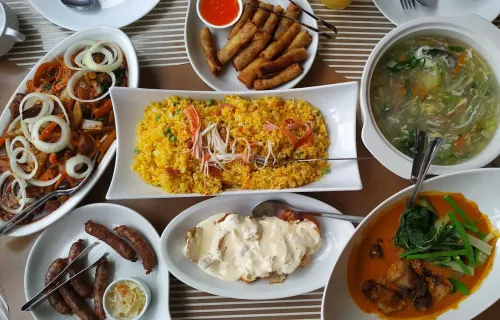
Filipino Food: 12 Essential Dishes (With Tagalog Names)
Filipino food, from adobo to halo-halo: learn the Tagalog names, pronunciations, and ingredients behind 12 dishes you'll want to try on your first trip.
Spaced Repetition for Tagalog: How Flashcards Make Words Stick
Cramming Tagalog vocabulary fails. See how spaced repetition — the science behind smart flashcards — makes words stick for the long term.