
From root: galit
Conjugations
Past (Completed)
kinagalitan
ki-na-ga-li-TAN
was angry at
Present (Incomplete)
kinagagalitan
ki-na-ga-ga-li-TAN
being angry at
Future (Contemplated)
kagagalitan
ka-ga-ga-li-TAN
will be angry at
Usage Note
Kagalitan is used when someone is the target of another person's anger or scolding, often implying a disciplinary context like a parent correcting a child. It focuses on the person being scolded as the subject of the sentence.
Examples
" Huwag mo akong kagalitan. "
Natural Translation
Don't be angry at me.
Literal Translation
Don't you me be-angry-at.
" Mahirap kagalitan ang taong mahal mo. "
Natural Translation
It is hard to be angry at the person you love.
Literal Translation
Hard be-angry-at the person-link love you.
" Hindi ko siya kayang kagalitan kahit nagkamali siya dahil alam kong nagsumikap naman talaga siya. "
Natural Translation
I cannot bring myself to scold him even though he made a mistake, because I know he really tried hard.
Literal Translation
Not I him able be-angry-at even mistaken he because know I strove indeed truly he.
Take Tagalog with you
The full course, a 12,500-word dictionary, and flashcards that make every word stick — free to start on iOS and Android.




Tagalog builds thousands of words from a few hundred roots.
How Tagalog words workWord family
galit has 9 related forms built from the same root.
Related Words
Explore Tagalog by topic
Free guides on grammar, vocabulary, and culture to take you past single-word lookups.

Tagalog Verb Conjugation: Aspects Made Simple
Tagalog verb conjugation uses aspects, not tenses. Learn the three aspects with -um- and mag- verbs, one reduplication rule, and clear example tables.
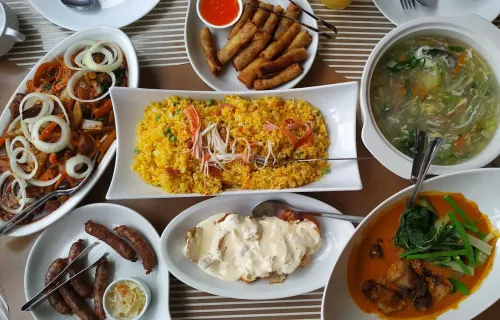
Filipino Food: 12 Essential Dishes (With Tagalog Names)
Filipino food, from adobo to halo-halo: learn the Tagalog names, pronunciations, and ingredients behind 12 dishes you'll want to try on your first trip.

Tagalog Numbers 1-100: Counting, Time & Money Explained
Learn Tagalog numbers 1-100 and beyond. Master both native and Spanish-derived counting systems, plus telling time, reading prices, and ordinals.

Mano Po and Filipino Etiquette: A Visitor's Guide
Mano po presses an elder's hand to your forehead as a blessing. Learn who to mano, how to lip-point, and the etiquette that wins over a Filipino family.