hiwalayin
hiwaláyin with stress marks
to separate [them]
From root: hiwalay
Conjugations
Past (Completed)
hiniwalay
hi-ni-WA-lay
separated
Present (Incomplete)
hinihiwalay
hi-ni-hi-WA-lay
is being separated
Future (Contemplated)
hihiwalayin
hi-hi-wa-LA-yin
will be separated
Usage Note
Hiwalayin is the object-focus infinitive of hiwalay, where the person, object, or entity being separated from another is the grammatical focus. It is used for both physical separation — sorting items — and social or relational separation, including ending a romantic relationship when the other person is the focus.
Examples
" Hiwalayin mo ang basura sa pagkain. "
Natural Translation
Separate the trash from the food.
Literal Translation
Separate you the trash from food.
" Kailangan hiwalayin ang mga basang papel sa tuyo. "
Natural Translation
It is necessary to separate the wet papers from the dry ones.
Literal Translation
Need to separate the wet paper from dry.
" Mahirap hiwalayin ang taong matagal mong minahal, kahit alam mong tama na ang magkahiwalay kayo. "
Natural Translation
It is hard to leave someone you loved for a long time, even when you know parting is the right thing.
Literal Translation
Hard to-separate the person long you loved, even know you correct already that separated you-plural.
Take Tagalog with you
The full course, a 12,500-word dictionary, and flashcards that make every word stick — free to start on iOS and Android.




Tagalog builds thousands of words from a few hundred roots.
How Tagalog words workWord family
hiwalay has 1 related form built from the same root.
Related Words
Explore Tagalog by topic
Free guides on grammar, vocabulary, and culture to take you past single-word lookups.

How to Say "I Love You" in Tagalog: Phrases & Meaning
Learn how to say I love you in Tagalog. Mahal kita, Iniibig kita, and Filipino terms of endearment for partners, family, and friends — with cultural notes.

Philippine Christmas Traditions: World's Longest Holiday
Philippine Christmas traditions run four months — from Ber-month carols to Simbang Gabi dawn masses, Noche Buena feasts, and parol lanterns lighting every street.
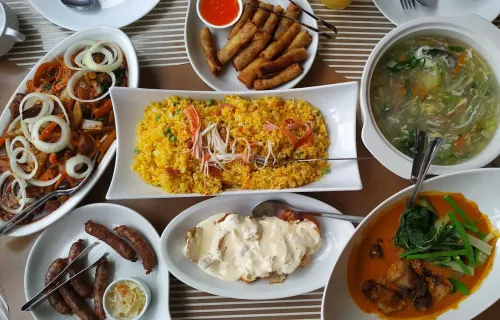
Filipino Food: 12 Essential Dishes (With Tagalog Names)
Filipino food, from adobo to halo-halo: learn the Tagalog names, pronunciations, and ingredients behind 12 dishes you'll want to try on your first trip.

Tagalog Verb Focus System Explained (It's Not Active vs. Passive)
The Tagalog verb focus system isn't active vs. passive. Learn actor focus, object focus, and more with clear examples that finally make it click.