From root: ibig
Conjugations
Past (Completed)
inibig
i-ni-BIG
loved
Present (Incomplete)
iniibig
i-ni-i-BIG
is loving
Future (Contemplated)
iibigin
i-i-bi-GIN
will love
Usage Note
Ibigin is a formal or poetic term for loving someone, often found in literature, songs, and traditional vows rather than casual conversation. It implies a deep, soul-level affection or a conscious choice to love, making it less frequent in daily speech compared to 'mahalin'.
Examples
" Iibigin kita magpakailanman. "
Natural Translation
I will love you forever.
Literal Translation
Will-love I-you forever.
" Gusto kitang ibigin habambuhay. "
Natural Translation
I want to love you forever.
Literal Translation
Want I-you to love forever-life.
" Nangako siyang iibigin ako nang tapat kahit anong pagsubok ang dumating sa aming buhay. "
Natural Translation
He promised to love me faithfully no matter what trials come into our life.
Literal Translation
Promised he to-love me with faithful even-if whatever trial the come to our life.
Take Tagalog with you
The full course, a 12,500-word dictionary, and flashcards that make every word stick — free to start on iOS and Android.




Tagalog builds thousands of words from a few hundred roots.
How Tagalog words workWord family
ibig has 8 related forms built from the same root.
Related Words
Explore Tagalog by topic
Free guides on grammar, vocabulary, and culture to take you past single-word lookups.

Tagalog Greetings: How to Say Hello, Goodbye & Po/Opo
Master Tagalog greetings with pronunciation: kumusta, magandang umaga, po and opo polite forms, time-of-day phrases, and the mano po tradition.
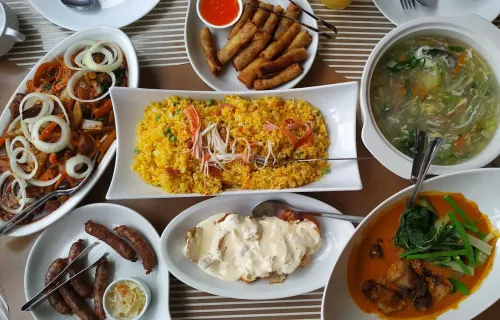
Filipino Food: 12 Essential Dishes (With Tagalog Names)
Filipino food, from adobo to halo-halo: learn the Tagalog names, pronunciations, and ingredients behind 12 dishes you'll want to try on your first trip.

Mano Po and Filipino Etiquette: A Visitor's Guide
Mano po presses an elder's hand to your forehead as a blessing. Learn who to mano, how to lip-point, and the etiquette that wins over a Filipino family.

Tagalog Question Words: Ano, Sino, Saan & More
Tagalog question words like ano, sino, and saan need the right frame to work. Learn the ang-vs-pronoun rule, confusable pairs, and the ba particle with audio.