
Usage Note
Iyak is the root for crying and appears most often in the actor-focus verb umiyak for the general act of crying and mag-iyak for intense or prolonged sobbing. The derived adjective iyakin describes a crybaby or someone who cries very easily — a word Filipinos reach for often when teasing a sensitive friend.
Examples
" Huwag kang umiyak. "
Natural Translation
Don't cry.
Literal Translation
Don't you to-cry.
" Tumigil na siya sa pag-iyak. "
Natural Translation
He stopped crying.
Literal Translation
Stopped already he/she in crying.
" Hindi niya napigilan ang iyak nang marinig ang masayang balita tungkol sa kanyang anak. "
Natural Translation
She couldn't hold back her tears when she heard the happy news about her child.
Literal Translation
Not she able-to-stop the cry when to-hear the happy news about her child.
Take Tagalog with you
The full course, a 12,500-word dictionary, and flashcards that make every word stick — free to start on iOS and Android.




Tagalog builds thousands of words from a few hundred roots.
How Tagalog words workDerived Words
Actor Focus Verbs
Object Focus Verbs
Related Words
Explore Tagalog by topic
Free guides on grammar, vocabulary, and culture to take you past single-word lookups.

Tagalog Question Words: Ano, Sino, Saan & More
Tagalog question words like ano, sino, and saan need the right frame to work. Learn the ang-vs-pronoun rule, confusable pairs, and the ba particle with audio.

Tagalog vs Filipino: What's the Difference & Which to Learn
Tagalog and Filipino aren't the same language — but they overlap almost completely. Here's the real difference and which one you should actually learn.

Tagalog Root Words: Learn a Few Hundred, Understand Thousands
Tagalog root words unlock vocabulary fast: learn a few hundred and recognize thousands. Real word families, examples, and a practical study strategy.
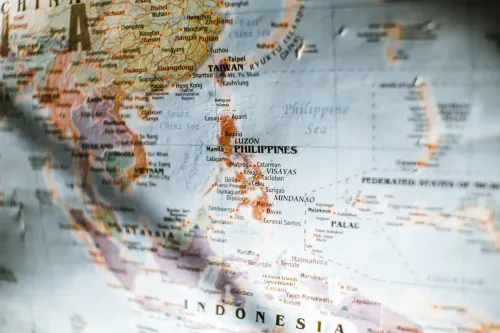
Philippines Geography for Learners: Islands & Language
Philippines geography for Tagalog learners: 7,641 islands, three island groups, and the Southern Luzon heartland where the Tagalog language was born.