
From root: kamay
Conjugations
Past (Completed)
kinamay
ki-NA-may
handled or ate with hands
Present (Incomplete)
kinakamay
ki-na-KA-may
handling or eating with hands
Future (Contemplated)
kakamayin
ka-ka-ma-YIN
will handle or eat with hands
Usage Note
Kamayin is used when eating food with bare hands, a traditional Filipino practice often associated with informal dining or 'boodle fights.' It can also refer to the manual handling of objects or materials without the use of tools.
Examples
" Huwag mong kamayin ang ulam. "
Natural Translation
Don't eat the viand with your hands.
Literal Translation
Don't you handle-with-hands the viand.
" Ayaw niyang kamayin ang kanin. "
Natural Translation
He doesn't want to eat the rice with his hands.
Literal Translation
Dislike he handle with-hands the rice.
" Mas masarap daw kamayin ang sinangag at daing kaysa kumain gamit ang kutsara. "
Natural Translation
They say fried rice and dried fish taste better eaten with the hands than with a spoon.
Literal Translation
More delicious they-say eat-with-hands the fried-rice and dried-fish than eat using the spoon.
Take Tagalog with you
The full course, a 12,500-word dictionary, and flashcards that make every word stick — free to start on iOS and Android.




Tagalog builds thousands of words from a few hundred roots.
How Tagalog words workWord family
kamay has 6 related forms built from the same root.
Related Words
Explore Tagalog by topic
Free guides on grammar, vocabulary, and culture to take you past single-word lookups.
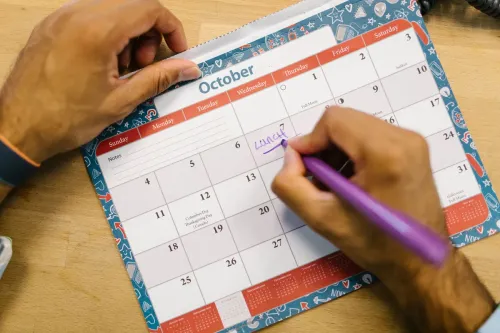
Days of the Week and Months in Tagalog
The days of the week and months in Tagalog are Spanish loanwords. Learn all 7 days and 12 months with pronunciation, plus how to say dates and 'every Monday.'

Spaced Repetition for Tagalog: How Flashcards Make Words Stick
Cramming Tagalog vocabulary fails. See how spaced repetition — the science behind smart flashcards — makes words stick for the long term.

Tagalog Pronouns Explained: Complete Chart with Examples
Every Tagalog pronoun explained with clear charts: ang/ng/sa forms, tayo vs kami, ikaw vs ka, politeness markers, and the mistakes beginners make.

Ang, Ng, Sa: The 3 Tagalog Case Markers Explained
Ang, ng, sa are the three Tagalog case markers every noun takes. Learn what each does, the personal forms si/ni/kay, plurals with mga, and clear examples.