kanaway
kanáway with stress marks
whiskered tern (bird)
Usage Note
Kanaway is the Tagalog name for the whiskered tern (Chlidonias hybrida), a migratory seabird that visits Philippine coastal and inland wetland areas. The name is primarily used in ornithological and naturalist contexts. Its native Tagalog origin reflects deep indigenous knowledge of local bird species and their behavior near water.
Examples
" Lumilipad ang kanaway sa lawa. "
Natural Translation
The whiskered tern flies over the lake.
Literal Translation
Flying the whiskered-tern at-the lake.
" Napanood namin ang kanaway na lumilipad sa ibabaw ng lawa. "
Natural Translation
We watched the whiskered tern flying over the lake.
Literal Translation
Watched we the whiskered-tern flying above the lake.
" Tuwing taglamig ay dumarating ang mga kanaway sa ating mga latian, kaya masaya ang mga mahilig manood ng ibon. "
Natural Translation
Every winter the whiskered terns arrive in our wetlands, so the bird-watchers are delighted.
Literal Translation
Every winter arrive the whiskered-terns at our wetlands, so happy the fond-of watching of bird.
Take Tagalog with you
The full course, a 12,500-word dictionary, and flashcards that make every word stick — free to start on iOS and Android.




Tagalog builds thousands of words from a few hundred roots.
How Tagalog words workRelated Words
Explore Tagalog by topic
Free guides on grammar, vocabulary, and culture to take you past single-word lookups.
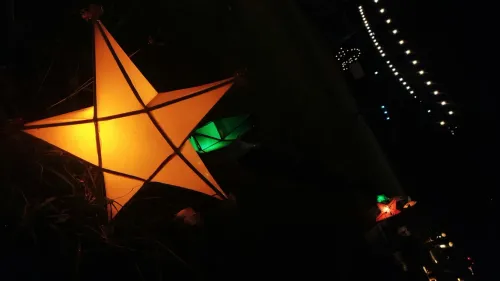
Philippine Christmas Traditions: World's Longest Holiday
Philippine Christmas traditions run four months — from Ber-month carols to Simbang Gabi dawn masses, Noche Buena feasts, and parol lanterns lighting every street.

Mano Po and Filipino Etiquette: A Visitor's Guide
Mano po presses an elder's hand to your forehead as a blessing. Learn who to mano, how to lip-point, and the etiquette that wins over a Filipino family.

Spaced Repetition for Tagalog: How Flashcards Make Words Stick
Cramming Tagalog vocabulary fails. See how spaced repetition — the science behind smart flashcards — makes words stick for the long term.

Ang, Ng, Sa: The 3 Tagalog Case Markers Explained
Ang, ng, sa are the three Tagalog case markers every noun takes. Learn what each does, the personal forms si/ni/kay, plurals with mga, and clear examples.