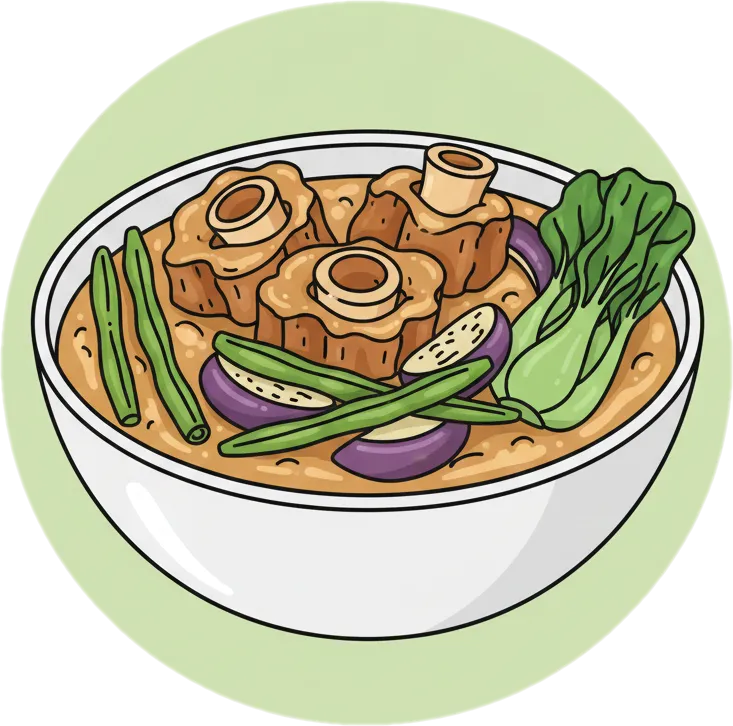
From root: kare-kare
Conjugations
Past (Completed)
kinare-kare
ki-na-re-ka-RE
cooked as kare-kare
Present (Incomplete)
kinaka-re-kare
ki-na-ka-re-ka-RE
cooking as kare-kare
Future (Contemplated)
kakare-karehin
ka-ka-re-ka-re-HIN
will cook as kare-kare
Usage Note
Kare-karehin is used when instructing someone to prepare a specific ingredient, such as oxtail or tripe, using the traditional Filipino peanut-based stew method. It is a specific cooking directive typically used in culinary contexts or household meal planning.
Examples
" Kare-karehin natin ang baka. "
Natural Translation
Let's cook the beef as kare-kare.
Literal Translation
Cook-as-kare-kare let-us the beef.
" Nagsimulang kare-karehin ni Lola ang baka. "
Natural Translation
Grandma started to cook the beef as kare-kare.
Literal Translation
Started-to cook-as-kare-kare by Grandma the beef.
" Kakare-karehin ni Lola ang buntot ng baka kapag may handaan ang aming pamilya sa Linggo. "
Natural Translation
Grandma will cook the oxtail as kare-kare whenever our family has a gathering on Sunday.
Literal Translation
Will-cook-as-kare-kare by Grandma the tail of beef when there-is gathering the our family on Sunday.
Take Tagalog with you
The full course, a 12,500-word dictionary, and flashcards that make every word stick — free to start on iOS and Android.




Tagalog builds thousands of words from a few hundred roots.
How Tagalog words workWord family
kare-kare has 3 related forms built from the same root.
Related Words
Explore Tagalog by topic
Free guides on grammar, vocabulary, and culture to take you past single-word lookups.

Tagalog Greetings: How to Say Hello, Goodbye & Po/Opo
Master Tagalog greetings with pronunciation: kumusta, magandang umaga, po and opo polite forms, time-of-day phrases, and the mano po tradition.
May vs Mayroon vs Meron: Have & There Is
May vs mayroon in Tagalog finally made simple: one rule decides which to use, plus how meron and wala fit the same have and there-is family.

Tagalog Word Order: Sentence Structure Made Simple
Why Tagalog puts the verb first, and how ang, ng, and sa markers work. A clear guide to VSO word order, forming questions, and negation.

Mano Po and Filipino Etiquette: A Visitor's Guide
Mano po presses an elder's hand to your forehead as a blessing. Learn who to mano, how to lip-point, and the etiquette that wins over a Filipino family.