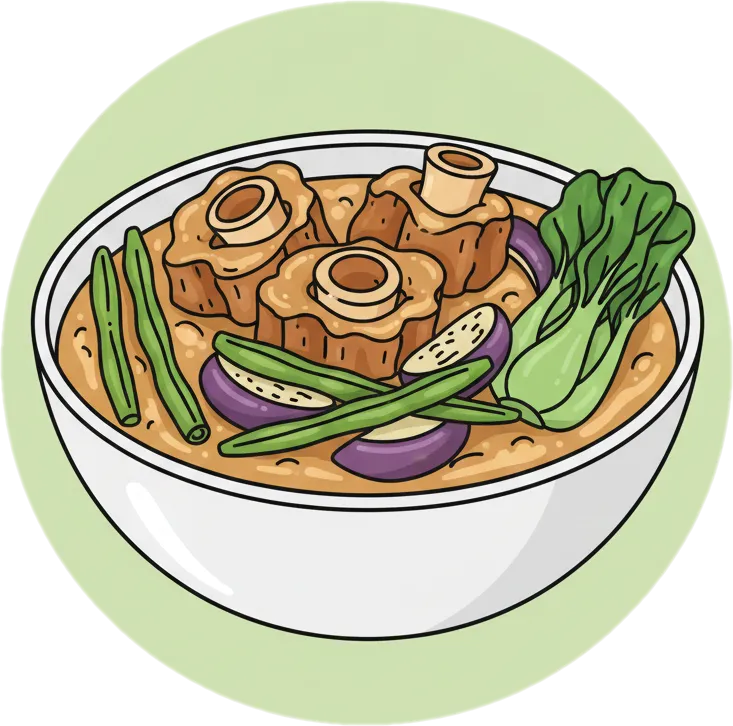
From root: kare-kare
Conjugations
Past (Completed)
nagkare-kare
nag-ka-re-ka-RE
cooked kare-kare
Present (Incomplete)
nagkakare-kare
nag-ka-ka-re-ka-RE
cooking kare-kare
Future (Contemplated)
magkakare-kare
mag-ka-ka-re-ka-RE
will cook kare-kare
Usage Note
Magkare-kare is used when specifically preparing the traditional peanut stew, often implying a special meal or celebration due to the dish's complexity. It is a more casual and direct way of saying 'magluto ng kare-kare' in everyday conversation.
Examples
" Magkare-kare tayo sa Linggo. "
Natural Translation
Let's cook kare-kare on Sunday.
Literal Translation
Cook-kare-kare we on Sunday.
" Mahirap magkare-kare pero masarap. "
Natural Translation
It is hard to cook kare-kare but it is delicious.
Literal Translation
Hard to-cook-kare-kare but delicious.
" Tuwing may handaan sa amin, ang lola ko ang nagkakare-kare dahil walang makatatapat sa lasa ng kanyang sariling sarsa. "
Natural Translation
Whenever there is a feast at our place, it is my grandmother who cooks the kare-kare because no one can match the taste of her own sauce.
Literal Translation
Every there feast at us, the grandmother my the cooking-kare-kare because none can-match to taste of her own sauce.
Take Tagalog with you
The full course, a 12,500-word dictionary, and flashcards that make every word stick — free to start on iOS and Android.




Tagalog builds thousands of words from a few hundred roots.
How Tagalog words workWord family
kare-kare has 3 related forms built from the same root.
Related Words
Explore Tagalog by topic
Free guides on grammar, vocabulary, and culture to take you past single-word lookups.
Tagalog Numbers 1-100: Counting, Time & Money Explained
Learn Tagalog numbers 1-100 and beyond. Master both native and Spanish-derived counting systems, plus telling time, reading prices, and ordinals.

May vs Mayroon vs Meron: Have & There Is
May vs mayroon in Tagalog finally made simple: one rule decides which to use, plus how meron and wala fit the same have and there-is family.
Philippine Christmas Traditions: World's Longest Holiday
Philippine Christmas traditions run four months — from Ber-month carols to Simbang Gabi dawn masses, Noche Buena feasts, and parol lanterns lighting every street.

Tagalog Time Expressions: Past, Present & Future Guide
Tagalog has no tenses — it uses aspect. Learn time words, days of the week, clock time, and the aspect system, with vocabulary tables and cultural notes.