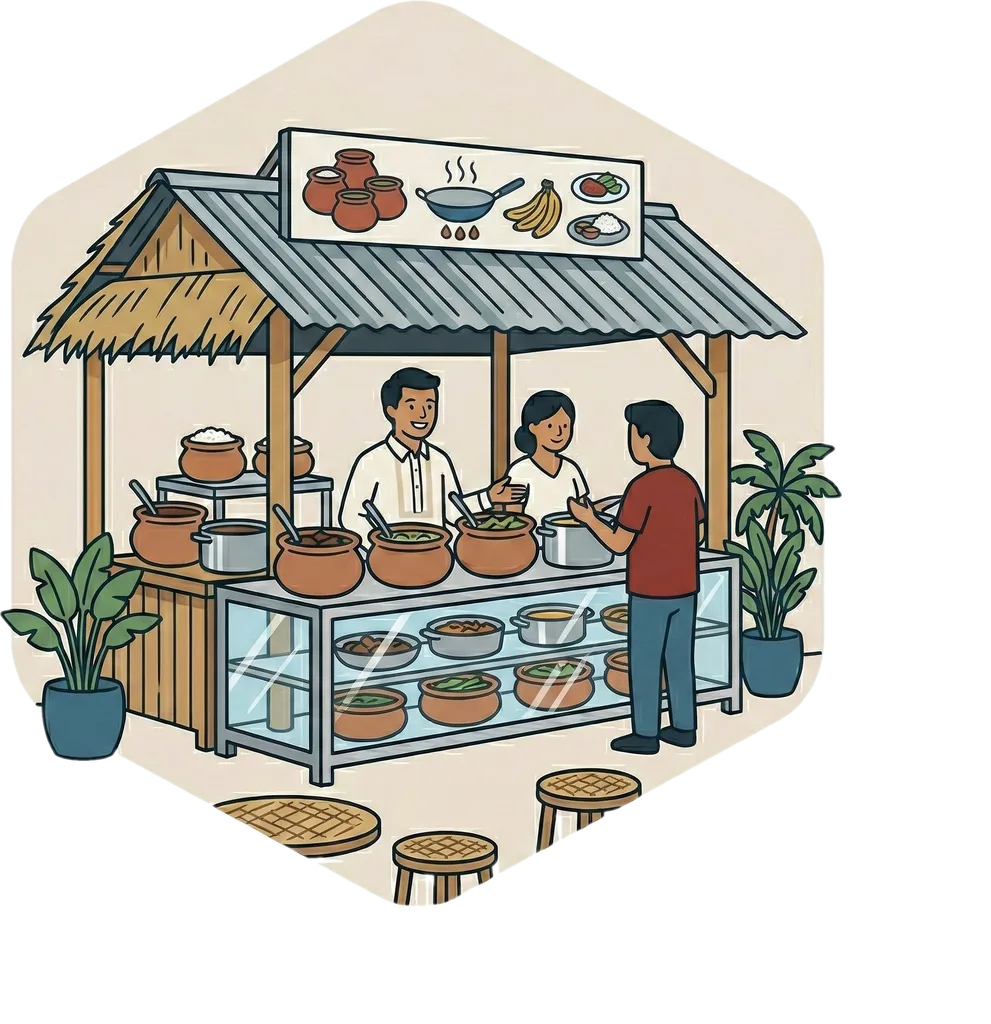
From root: karinderya
Conjugations
Past (Completed)
nagkarinderya
nag-ka-rin-DER-ya
ran an eatery
Present (Incomplete)
nagkakarinderya
nag-ka-ka-rin-DER-ya
running an eatery
Future (Contemplated)
magkakarinderya
mag-ka-ka-rin-DER-ya
will run an eatery
Usage Note
Magkarinderya is used when someone decides to open or operate a small, local eatery, typically serving affordable home-cooked meals to the public. It is a common term when discussing livelihood or small business ventures within a neighborhood.
Examples
" Gusto kong magkarinderya balang araw. "
Natural Translation
I want to run an eatery someday.
Literal Translation
Want I run-eatery some day.
" Balak nilang magkarinderya sa tapat ng school. "
Natural Translation
They plan to run an eatery in front of the school.
Literal Translation
Plan they run-eatery at front of school.
" Nang mawalan ng trabaho, nagpasya ang mag-asawang magkarinderya para may pagkakakitaan sa kanilang barangay. "
Natural Translation
When they lost their jobs, the couple decided to run an eatery to have a source of income in their barangay.
Literal Translation
When lost of work, decided the couple run-eatery so there-is source-of-income in their barangay.
Take Tagalog with you
The full course, a 12,500-word dictionary, and flashcards that make every word stick — free to start on iOS and Android.




Tagalog builds thousands of words from a few hundred roots.
How Tagalog words workWord family
karinderya has 3 related forms built from the same root.
Related Words
Explore Tagalog by topic
Free guides on grammar, vocabulary, and culture to take you past single-word lookups.

Tagalog Pronouns Explained: Complete Chart with Examples
Every Tagalog pronoun explained with clear charts: ang/ng/sa forms, tayo vs kami, ikaw vs ka, politeness markers, and the mistakes beginners make.

Tagalog Word Order: Sentence Structure Made Simple
Why Tagalog puts the verb first, and how ang, ng, and sa markers work. A clear guide to VSO word order, forming questions, and negation.

Filipino Family Words and Honorifics: Ate, Kuya & Tita
Filipino family words like ate, kuya, tita, tito, lolo, and lola go far beyond family — learn how Filipinos use them with strangers, plus mano po etiquette.

Mano Po and Filipino Etiquette: A Visitor's Guide
Mano po presses an elder's hand to your forehead as a blessing. Learn who to mano, how to lip-point, and the etiquette that wins over a Filipino family.