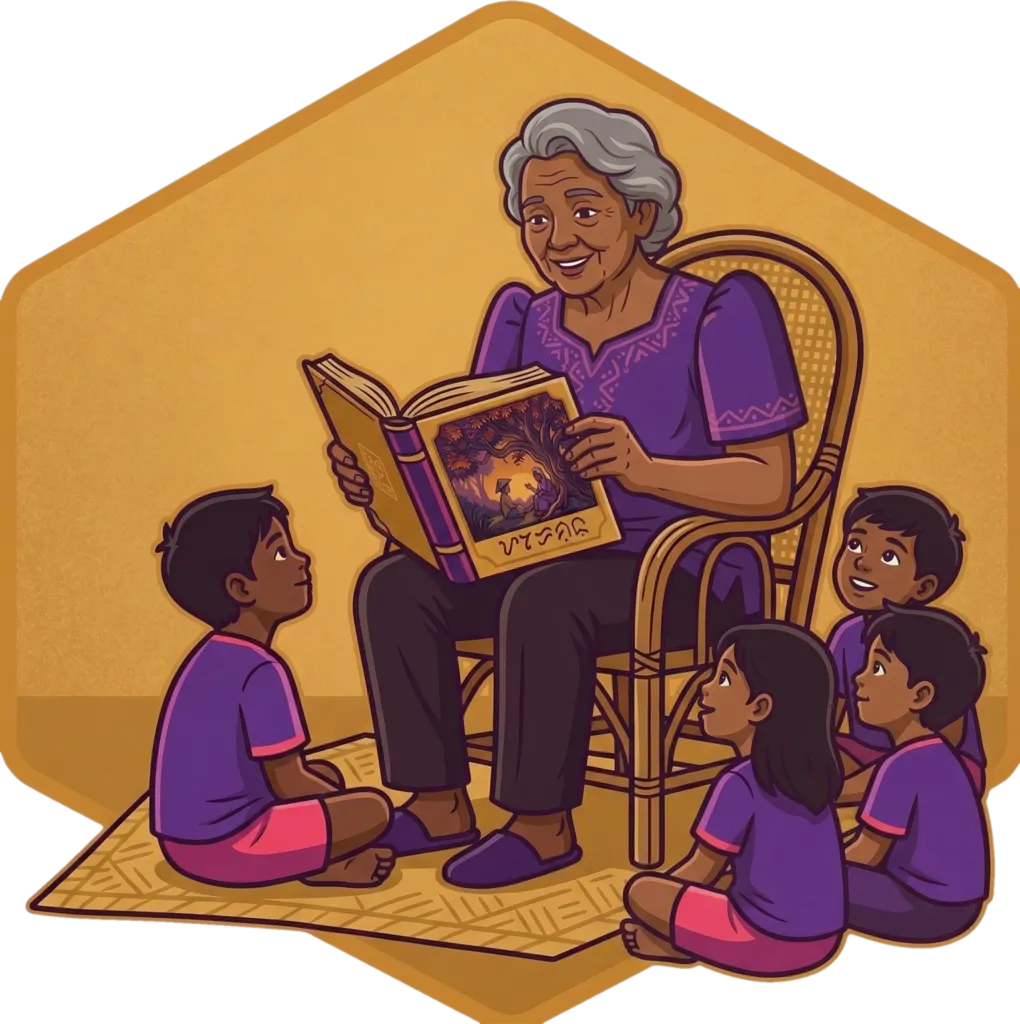
From root: kwento
Conjugations
Past (Completed)
kinwento
ki-NWEN-to
narrated something
Present (Incomplete)
kinukwento
ki-nu-KWEN-to
narrating something
Future (Contemplated)
kukwentuhin
ku-kwen-tu-HIN
will narrate something
Usage Note
Kwentuhin is used when the focus of the sentence is the specific story, experience, or event being narrated to an audience. It is often employed when someone is requested to tell a particular tale in detail rather than just engaging in general conversation.
Examples
" Kwentuhin mo ang nangyari. "
Natural Translation
Narrate what happened.
Literal Translation
Narrate you the happened.
" Huwag mong subukang kwentuhin ang katabi mo. "
Natural Translation
Don't try to narrate to the person beside you.
Literal Translation
Do-not by-you to-narrate-to the beside of-you.
" Hiniling ng mga bata na kwentuhin sila ni Lolo tungkol sa buhay nito noong panahon ng digmaan. "
Natural Translation
The children asked Grandpa to tell them the story about his life during the time of the war.
Literal Translation
Requested of the children that narrate-to them by Grandpa about the life his during time of war.
Take Tagalog with you
The full course, a 12,500-word dictionary, and flashcards that make every word stick — free to start on iOS and Android.




Tagalog builds thousands of words from a few hundred roots.
How Tagalog words workWord family
kwento has 7 related forms built from the same root.
Related Words
Explore Tagalog by topic
Free guides on grammar, vocabulary, and culture to take you past single-word lookups.

Tagalog Pronouns Explained: Complete Chart with Examples
Every Tagalog pronoun explained with clear charts: ang/ng/sa forms, tayo vs kami, ikaw vs ka, politeness markers, and the mistakes beginners make.

Ng vs Nang in Tagalog: The Spelling Rule
Ng vs nang sound identical but spell differently. Use ng to mark nouns (of, the object), and nang for how, when, repetition, and counting time.

Tagalog Time Expressions: Past, Present & Future Guide
Tagalog has no tenses — it uses aspect. Learn time words, days of the week, clock time, and the aspect system, with vocabulary tables and cultural notes.

Tagalog Greetings: How to Say Hello, Goodbye & Po/Opo
Master Tagalog greetings with pronunciation: kumusta, magandang umaga, po and opo polite forms, time-of-day phrases, and the mano po tradition.