miyembro
miyémbro with stress marks
member
Usage Note
Miyembro is borrowed from Spanish miembro and means member of an organization, club, church, or group. In Philippine civic and political life, being a miyembro of a barangay committee or neighborhood association is common and the word is heard across all registers of daily conversation.
Examples
" Miyembro ako ng samahan. "
Natural Translation
I'm a member of the group.
Literal Translation
Member I of group.
" Ako ay naging opisyal na miyembro ng kanilang samahan kahapon. "
Natural Translation
I became an official member of their organization yesterday.
Literal Translation
I is became official that member of their organization yesterday.
" Bawat miyembro ng samahan ay inaasahang dumalo sa buwanang pulong upang talakayin ang mga proyekto sa barangay. "
Natural Translation
Every member of the organization is expected to attend the monthly meeting to discuss the barangay projects.
Literal Translation
Every member of organization is expected to-attend at-the monthly meeting in-order-to discuss the projects in barangay.
Take Tagalog with you
The full course, a 12,500-word dictionary, and flashcards that make every word stick — free to start on iOS and Android.




Tagalog builds thousands of words from a few hundred roots.
How Tagalog words workRelated Words
- AWOL absence without leave
- Amboy short for American boy
- Ati ethnolinguistic group in Panay
- Balbalan ethnolinguistic group (Kalinga)
- Hiligaynon ethnolinguistic group/language
- Ilokana female native of the Ilocos region; Ilokana woman
- Ilokano Ethnolinguistic group in Ilocos
- Ilonggo Language/People of Western Visayas
Explore Tagalog by topic
Free guides on grammar, vocabulary, and culture to take you past single-word lookups.
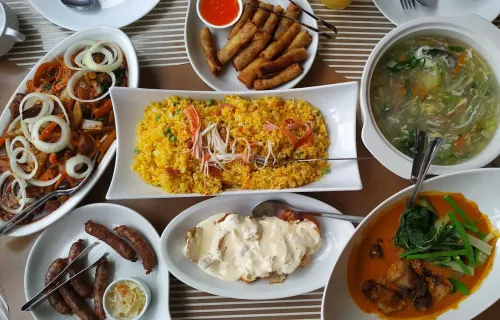
Filipino Food: 12 Essential Dishes (With Tagalog Names)
Filipino food, from adobo to halo-halo: learn the Tagalog names, pronunciations, and ingredients behind 12 dishes you'll want to try on your first trip.

Spaced Repetition for Tagalog: How Flashcards Make Words Stick
Cramming Tagalog vocabulary fails. See how spaced repetition — the science behind smart flashcards — makes words stick for the long term.

Ang, Ng, Sa: The 3 Tagalog Case Markers Explained
Ang, ng, sa are the three Tagalog case markers every noun takes. Learn what each does, the personal forms si/ni/kay, plurals with mga, and clear examples.

Mano Po and Filipino Etiquette: A Visitor's Guide
Mano po presses an elder's hand to your forehead as a blessing. Learn who to mano, how to lip-point, and the etiquette that wins over a Filipino family.