
From root: mukha
Conjugations
Past (Completed)
ipinagmukha
i-pi-nag-muk-HA
made look like
Present (Incomplete)
ipinapagmukha
i-pi-na-pag-muk-HA
making look like
Future (Contemplated)
ipapagmukha
i-pa-pag-muk-HA
will make look like
Usage Note
Ipagmukha is used when one intentionally makes someone or something appear a certain way to others, often used in expressions like 'making someone look like a fool.' It conveys a deliberate effort to manipulate perception or appearance.
Examples
" Huwag mo akong ipagmukhang tanga. "
Natural Translation
Don't make me look stupid.
Literal Translation
Don't you me make-look-like stupid.
" Gusto nilang ipagmukha siyang mayaman. "
Natural Translation
They want to make him look rich.
Literal Translation
Want they make-look-like him rich.
" Sinubukan niyang ipagmukha akong masama sa harap ng aming mga kaibigan, pero hindi naniwala ang mga ito. "
Natural Translation
He tried to make me look bad in front of our friends, but they didn't believe it.
Literal Translation
Tried he make-look-like me bad in front of our plural friend, but not believed the these.
Take Tagalog with you
The full course, a 12,500-word dictionary, and flashcards that make every word stick — free to start on iOS and Android.




Tagalog builds thousands of words from a few hundred roots.
How Tagalog words workWord family
mukha has 9 related forms built from the same root.
Related Words
Explore Tagalog by topic
Free guides on grammar, vocabulary, and culture to take you past single-word lookups.
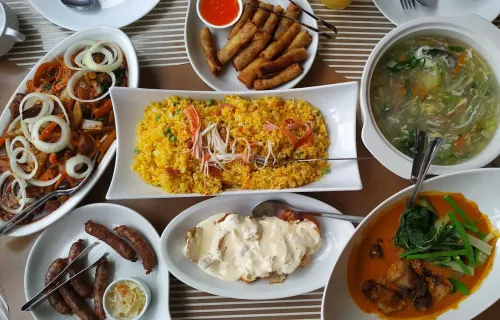
Filipino Food: 12 Essential Dishes (With Tagalog Names)
Filipino food, from adobo to halo-halo: learn the Tagalog names, pronunciations, and ingredients behind 12 dishes you'll want to try on your first trip.

Po and Opo in Tagalog: Where to Put Them Right
Po and opo confuse learners — but placement follows one rule. Where po goes in a sentence, why it's opo not 'oo po', and the pronoun shift to learn.
May vs Mayroon vs Meron: Have & There Is
May vs mayroon in Tagalog finally made simple: one rule decides which to use, plus how meron and wala fit the same have and there-is family.

Ang, Ng, Sa: The 3 Tagalog Case Markers Explained
Ang, ng, sa are the three Tagalog case markers every noun takes. Learn what each does, the personal forms si/ni/kay, plurals with mga, and clear examples.