Usage Note
Oksidasyon is adapted from English 'oxidation' and is a scientific term used in chemistry, biology, and materials science to describe the process by which a substance loses electrons, often combining with oxygen. It is taught in Philippine high school and university science classes and may be encountered in everyday discussions of rust or food spoilage.
Examples
" Nagdudulot ng kalawang ang oksidasyon. "
Natural Translation
Oxidation causes rust.
Literal Translation
Causes of rust the oxidation.
" Ang oksidasyon ay nagdudulot ng kalawang sa bakal. "
Natural Translation
Oxidation causes rust on iron.
Literal Translation
The oxidation causes of rust on iron.
" Ipinaliwanag ng guro na ang oksidasyon ang dahilan kung bakit nangingitim ang hiniwang mansanas kapag naiwang nakalantad sa hangin. "
Natural Translation
The teacher explained that oxidation is the reason why a sliced apple darkens when it is left exposed to air.
Literal Translation
Explained of teacher that the oxidation the reason why darkens the sliced apple when left exposed to air.
Take Tagalog with you
The full course, a 12,500-word dictionary, and flashcards that make every word stick — free to start on iOS and Android.




Tagalog builds thousands of words from a few hundred roots.
How Tagalog words workRelated Words
Explore Tagalog by topic
Free guides on grammar, vocabulary, and culture to take you past single-word lookups.
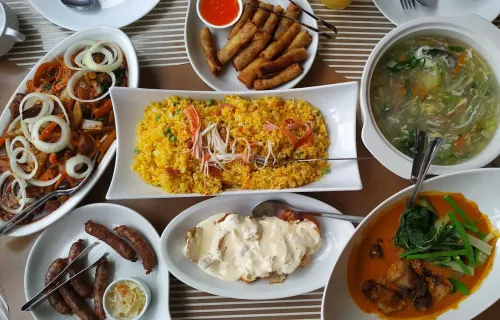
Filipino Food: 12 Essential Dishes (With Tagalog Names)
Filipino food, from adobo to halo-halo: learn the Tagalog names, pronunciations, and ingredients behind 12 dishes you'll want to try on your first trip.

Tagalog Numbers 1-100: Counting, Time & Money Explained
Learn Tagalog numbers 1-100 and beyond. Master both native and Spanish-derived counting systems, plus telling time, reading prices, and ordinals.

Ng vs Nang in Tagalog: The Spelling Rule
Ng vs nang sound identical but spell differently. Use ng to mark nouns (of, the object), and nang for how, when, repetition, and counting time.

Tagalog Greetings: How to Say Hello, Goodbye & Po/Opo
Master Tagalog greetings with pronunciation: kumusta, magandang umaga, po and opo polite forms, time-of-day phrases, and the mano po tradition.