okupa
okúpa with stress marks
to occupy; dwell; colonize
Usage Note
Okupa is borrowed from Spanish 'ocupar' and is used for both physical occupation of a space and the historical sense of colonial occupation. In modern Filipino it often appears in discussions of squatters occupying land or in military and political contexts.
Examples
" Huwag mong okupahin ang upuan ko. "
Natural Translation
Don't occupy my seat.
Literal Translation
Do-not you occupy the seat my.
" Huwag mong okupa ang espasyo ng iba. "
Natural Translation
Do not occupy the space of others.
Literal Translation
Do-not you occupy the space of others.
" Mahigit tatlong taon na inookupa ng mga pamilya ang lupang iyon bago sila pinaalis ng mga awtoridad noong nakaraang buwan. "
Natural Translation
The families had been occupying that land for over three years before they were evicted by the authorities last month.
Literal Translation
More-than three [na] year now occupying of-the plural family the land [na] that before they made-to-leave by-the plural authority last [na] month.
Take Tagalog with you
The full course, a 12,500-word dictionary, and flashcards that make every word stick — free to start on iOS and Android.




Tagalog builds thousands of words from a few hundred roots.
How Tagalog words workActor Focus Verbs
Object Focus Verbs
Related Words
Explore Tagalog by topic
Free guides on grammar, vocabulary, and culture to take you past single-word lookups.
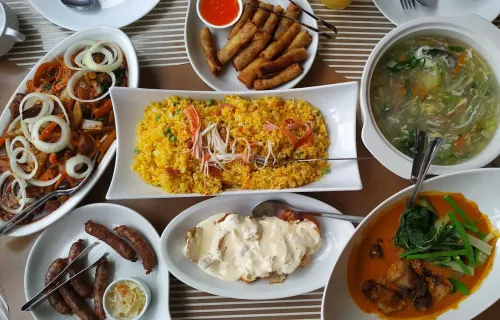
Filipino Food: 12 Essential Dishes (With Tagalog Names)
Filipino food, from adobo to halo-halo: learn the Tagalog names, pronunciations, and ingredients behind 12 dishes you'll want to try on your first trip.

Tagalog Verb Focus System Explained (It's Not Active vs. Passive)
The Tagalog verb focus system isn't active vs. passive. Learn actor focus, object focus, and more with clear examples that finally make it click.

Na vs -ng in Tagalog: The Linker Rule Made Simple
When do you use na vs -ng in Tagalog? One simple rule, with clear examples, memory tips, and common mistakes explained for English-speaking beginners.

Tagalog Root Words: Learn a Few Hundred, Understand Thousands
Tagalog root words unlock vocabulary fast: learn a few hundred and recognize thousands. Real word families, examples, and a practical study strategy.