From root: pinta
Conjugations
Past (Completed)
pinintahan
pi-nin-TA-han
painted
Present (Incomplete)
pinipintahan
pi-ni-pin-TA-han
painting
Future (Contemplated)
pipintahan
pi-pin-TA-han
will paint
Usage Note
Pintahan is used when the focus of the sentence is the specific surface or object being covered with paint, such as a wall or a chair. This verb emphasizes the destination of the paint rather than the person doing the painting.
Examples
" Pintahan mo ang dingding. "
Natural Translation
Paint the wall.
Literal Translation
Paint you the wall.
" Kailangan mong pintahan ang pader. "
Natural Translation
You need to paint the wall.
Literal Translation
Need you paint the wall.
" Bago dumating ang mga bisita, pintahan natin ng puti ang bakod para mukhang bago ang buong bahay. "
Natural Translation
Before the guests arrive, let's paint the fence white so that the whole house looks new.
Literal Translation
Before arrive the guests, paint we of white the fence so-that look new the whole house.
Take Tagalog with you
The full course, a 12,500-word dictionary, and flashcards that make every word stick — free to start on iOS and Android.




Tagalog builds thousands of words from a few hundred roots.
How Tagalog words workWord family
pinta has 6 related forms built from the same root.
Related Words
Explore Tagalog by topic
Free guides on grammar, vocabulary, and culture to take you past single-word lookups.

Mano Po and Filipino Etiquette: A Visitor's Guide
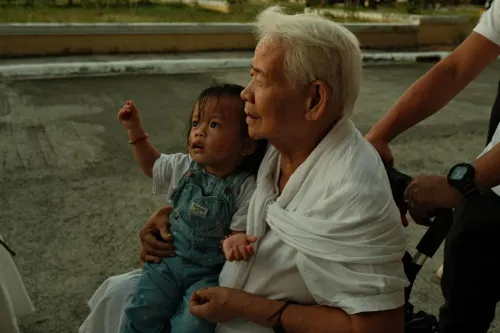
Mano po presses an elder's hand to your forehead as a blessing. Learn who to mano, how to lip-point, and the etiquette that wins over a Filipino family.

Tagalog Time Expressions: Past, Present & Future Guide
Tagalog has no tenses — it uses aspect. Learn time words, days of the week, clock time, and the aspect system, with vocabulary tables and cultural notes.

Spaced Repetition for Tagalog: How Flashcards Make Words Stick
Cramming Tagalog vocabulary fails. See how spaced repetition — the science behind smart flashcards — makes words stick for the long term.
Po and Opo in Tagalog: Where to Put Them Right
Po and opo confuse learners — but placement follows one rule. Where po goes in a sentence, why it's opo not 'oo po', and the pronoun shift to learn.