sanay
sanáy with stress marks
training; exercise; skilled/expert
Usage Note
Sanay can function both as a noun (the training or practice itself) and as an adjective describing someone who is accustomed to or skilled at something. Phrases like 'sanay na ako' ('I'm used to it') are extremely common in everyday Tagalog, expressing habituation or resilience born of experience.
Examples
" Sanay na ako rito. "
Natural Translation
I'm used to this already.
Literal Translation
Used-to already I here.
" Siya ay sanay na sa trabaho. "
Natural Translation
He/She is already skilled in the job.
Literal Translation
He/She is skilled already in job.
" Mahirap man noong una, sanay na sanay na siya ngayon sa mabigat na gawain sa pagawaan. "
Natural Translation
Though it was hard at first, he is now thoroughly accustomed to the heavy work at the factory.
Literal Translation
Hard although at first, used-to very already he now in heavy that work in factory.
Take Tagalog with you
The full course, a 12,500-word dictionary, and flashcards that make every word stick — free to start on iOS and Android.




Tagalog builds thousands of words from a few hundred roots.
How Tagalog words workDerived Words
Related Words
Explore Tagalog by topic
Free guides on grammar, vocabulary, and culture to take you past single-word lookups.

Seasons in the Philippines: A Tagalog Guide
The Philippines has two seasons, not four. Learn tag-araw, tag-ulan, and taglamig, the generative tag- prefix, and the weather vocabulary to match.
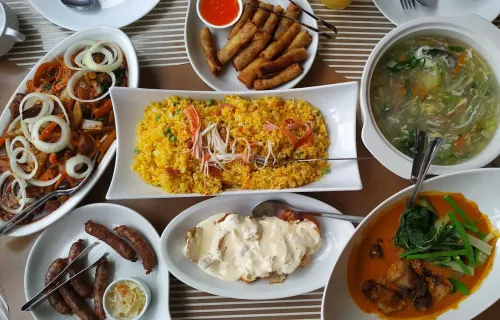
Filipino Food: 12 Essential Dishes (With Tagalog Names)
Filipino food, from adobo to halo-halo: learn the Tagalog names, pronunciations, and ingredients behind 12 dishes you'll want to try on your first trip.

Tagalog Verb Conjugation: Aspects Made Simple
Tagalog verb conjugation uses aspects, not tenses. Learn the three aspects with -um- and mag- verbs, one reduplication rule, and clear example tables.

Tagalog Time Expressions: Past, Present & Future Guide
Tagalog has no tenses — it uses aspect. Learn time words, days of the week, clock time, and the aspect system, with vocabulary tables and cultural notes.