soborno
sobórno with stress marks
bribe
Usage Note
Soborno is borrowed from Spanish 'soborno' and refers to a bribe offered to corrupt an official or gain unfair advantage. It is used in legal, journalistic, and political contexts and carries a strongly negative connotation; the closely related everyday Filipino concept is lagay, a more informal bribe.
Examples
" Tumanggap ng soborno ang pulis. "
Natural Translation
The police officer accepted a bribe.
Literal Translation
Accepted of bribe the police.
" Bawal tumanggap ng soborno. "
Natural Translation
It is forbidden to accept a bribe.
Literal Translation
Forbidden to accept of bribe.
" Natanggal sa puwesto ang opisyal nang mapatunayang tumanggap siya ng malaking soborno mula sa kontratista. "
Natural Translation
The official was removed from his post when it was proven that he accepted a large bribe from the contractor.
Literal Translation
Removed from post the official when proven accepted he of large bribe from contractor.
Take Tagalog with you
The full course, a 12,500-word dictionary, and flashcards that make every word stick — free to start on iOS and Android.




Tagalog builds thousands of words from a few hundred roots.
How Tagalog words workRelated Words
Explore Tagalog by topic
Free guides on grammar, vocabulary, and culture to take you past single-word lookups.
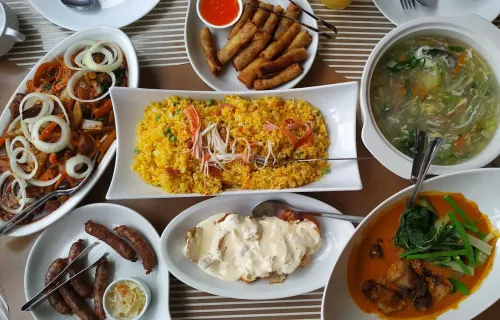
Filipino Food: 12 Essential Dishes (With Tagalog Names)
Filipino food, from adobo to halo-halo: learn the Tagalog names, pronunciations, and ingredients behind 12 dishes you'll want to try on your first trip.

Ng vs Nang in Tagalog: The Spelling Rule
Ng vs nang sound identical but spell differently. Use ng to mark nouns (of, the object), and nang for how, when, repetition, and counting time.

Tagalog vs Filipino: What's the Difference & Which to Learn
Tagalog and Filipino aren't the same language — but they overlap almost completely. Here's the real difference and which one you should actually learn.

Mano Po and Filipino Etiquette: A Visitor's Guide
Mano po presses an elder's hand to your forehead as a blessing. Learn who to mano, how to lip-point, and the etiquette that wins over a Filipino family.