solo
single; alone; to do alone
Usage Note
Solo is an English loanword widely used in Filipino casual speech to describe doing something unaccompanied, from dining alone to performing a solo in music. It is fully naturalized and used across all age groups and contexts without the need for translation.
Examples
" Solo akong kumain ngayon. "
Natural Translation
I ate alone today.
Literal Translation
Alone I ate today.
" Gusto niyang maging solo sa buhay. "
Natural Translation
He/she wants to be single in life.
Literal Translation
Wants he/she to be single in life.
" Mas gusto niyang mag-solo sa paglalakbay dahil malaya niyang napupuntahan ang lahat ng gustong puntahan nang walang naghihintay. "
Natural Translation
He prefers to travel solo because he can freely go to all the places he wants without anyone waiting.
Literal Translation
More prefers he to-solo in travel because freely he can-go-to the all of want go-to with-none waiting.
Take Tagalog with you
The full course, a 12,500-word dictionary, and flashcards that make every word stick — free to start on iOS and Android.




Tagalog builds thousands of words from a few hundred roots.
How Tagalog words workActor Focus Verbs
Object Focus Verbs
Related Words
Explore Tagalog by topic
Free guides on grammar, vocabulary, and culture to take you past single-word lookups.

Tagalog Numbers 1-100: Counting, Time & Money Explained
Learn Tagalog numbers 1-100 and beyond. Master both native and Spanish-derived counting systems, plus telling time, reading prices, and ordinals.

May vs Mayroon vs Meron: Have & There Is
May vs mayroon in Tagalog finally made simple: one rule decides which to use, plus how meron and wala fit the same have and there-is family.
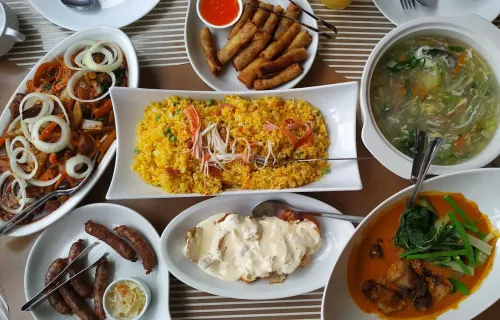
Filipino Food: 12 Essential Dishes (With Tagalog Names)
Filipino food, from adobo to halo-halo: learn the Tagalog names, pronunciations, and ingredients behind 12 dishes you'll want to try on your first trip.

Na vs -ng in Tagalog: The Linker Rule Made Simple
When do you use na vs -ng in Tagalog? One simple rule, with clear examples, memory tips, and common mistakes explained for English-speaking beginners.