From root: tigas
Conjugations
Past (Completed)
pinatigas
pi-na-ti-GAS
made hard
Present (Incomplete)
pinapatigas
pi-na-pa-ti-GAS
making hard
Future (Contemplated)
papatigasin
pa-pa-ti-ga-SIN
will make hard
Usage Note
Patigasin is used when an actor causes an object to become hard or rigid, such as letting gelatin set or allowing cement to dry. It is commonly used in culinary, construction, or physical contexts where a material needs to reach a solid state.
Examples
" Patigasin mo ang gulaman. "
Natural Translation
Let the gelatin set.
Literal Translation
Make-hard you the gelatin.
" Kailangan mong patigasin ang semento. "
Natural Translation
You need to make the cement hard.
Literal Translation
Need you make-hard the cement.
" Matapos ibuhos ang semento sa hulmahan, kailangan mong patigasin ito nang ilang araw bago dumagan ang mga manggagawa. "
Natural Translation
After pouring the cement into the mold, you need to let it harden for a few days before the workers put weight on it.
Literal Translation
After poured the cement in mold, need you make-hard it for some days before put-weight the workers.
Take Tagalog with you
The full course, a 12,500-word dictionary, and flashcards that make every word stick — free to start on iOS and Android.




Tagalog builds thousands of words from a few hundred roots.
How Tagalog words workWord family
tigas has 5 related forms built from the same root.
Explore Tagalog by topic
Free guides on grammar, vocabulary, and culture to take you past single-word lookups.

Mano Po and Filipino Etiquette: A Visitor's Guide
Mano po presses an elder's hand to your forehead as a blessing. Learn who to mano, how to lip-point, and the etiquette that wins over a Filipino family.

Tagalog Verb Conjugation: Aspects Made Simple
Tagalog verb conjugation uses aspects, not tenses. Learn the three aspects with -um- and mag- verbs, one reduplication rule, and clear example tables.

Seasons in the Philippines: A Tagalog Guide
The Philippines has two seasons, not four. Learn tag-araw, tag-ulan, and taglamig, the generative tag- prefix, and the weather vocabulary to match.
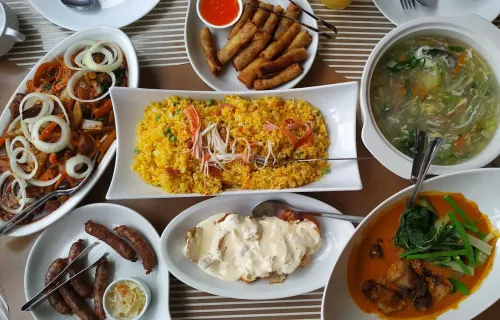
Filipino Food: 12 Essential Dishes (With Tagalog Names)
Filipino food, from adobo to halo-halo: learn the Tagalog names, pronunciations, and ingredients behind 12 dishes you'll want to try on your first trip.