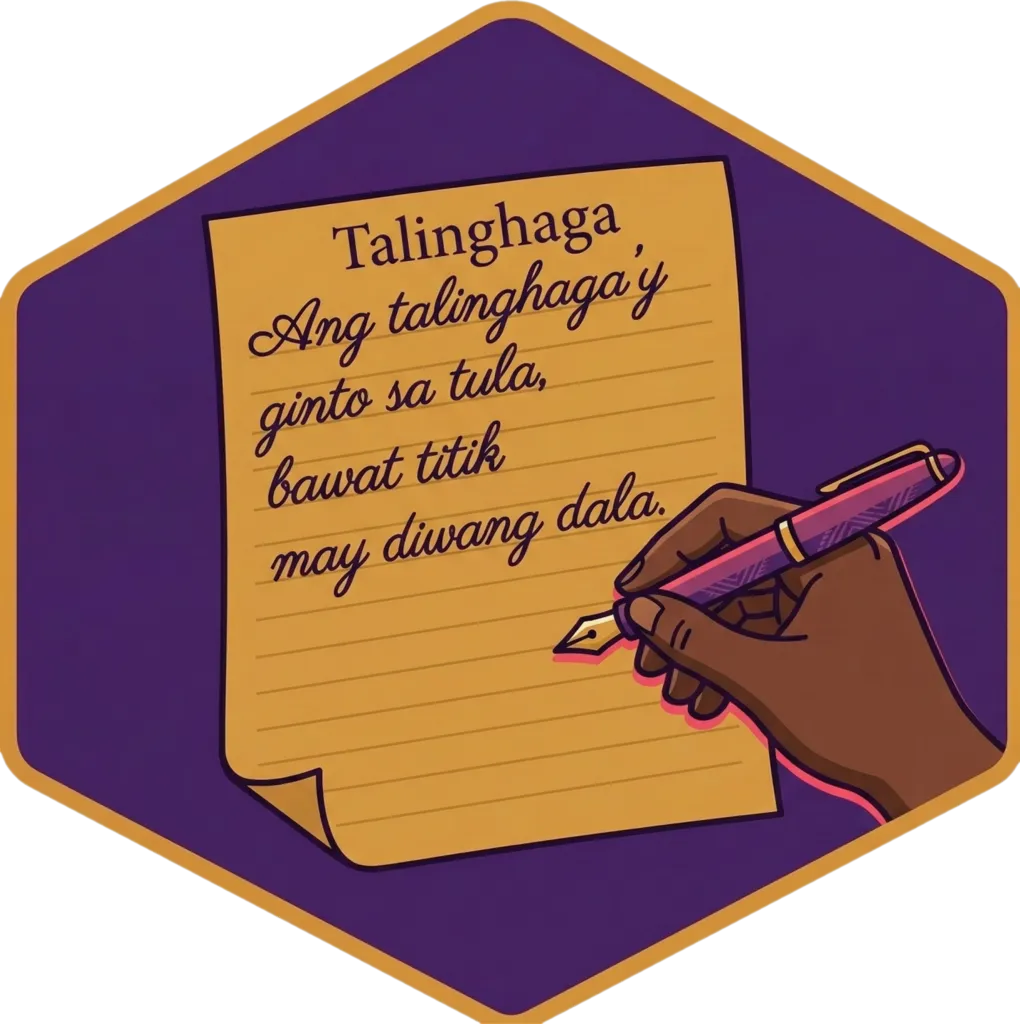
From root: tula
Conjugations
Past (Completed)
tumula
tu-MU-la
wrote poetry
Present (Incomplete)
tumutula
tu-mu-TU-la
writing poetry
Future (Contemplated)
tutula
tu-TU-la
will write poetry
Usage Note
Tumula is used when an individual creates or recites a poem, often in the context of school performances or formal cultural programs. It emphasizes the active performance or artistic expression of poetry rather than just the act of writing it.
Examples
" Marunong siyang tumula. "
Natural Translation
She knows how to write poetry.
Literal Translation
Knows she to-write-poetry.
" Nagsimula siyang tumula para sa kanyang kasintahan. "
Natural Translation
She started to write poetry for her sweetheart.
Literal Translation
Started she to write poetry for her sweetheart.
" Tuwing malungkot siya, tumutula siya tungkol sa pag-ibig na hindi natupad at sa mga pangarap na naglaho. "
Natural Translation
Whenever she is sad, she writes poetry about love that was not fulfilled and dreams that have vanished.
Literal Translation
Whenever sad she, writing-poetry she about love that not fulfilled and about the dreams that vanished.
Take Tagalog with you
The full course, a 12,500-word dictionary, and flashcards that make every word stick — free to start on iOS and Android.




Tagalog builds thousands of words from a few hundred roots.
How Tagalog words workWord family
tula has 7 related forms built from the same root.
Related Words
Explore Tagalog by topic
Free guides on grammar, vocabulary, and culture to take you past single-word lookups.

Tagalog Pronouns Explained: Complete Chart with Examples
Every Tagalog pronoun explained with clear charts: ang/ng/sa forms, tayo vs kami, ikaw vs ka, politeness markers, and the mistakes beginners make.

Ng vs Nang in Tagalog: The Spelling Rule
Ng vs nang sound identical but spell differently. Use ng to mark nouns (of, the object), and nang for how, when, repetition, and counting time.

Is Tagalog Hard to Learn? An Honest Answer
Tagalog takes around 1,100 hours to reach professional proficiency. Here is what is easy, what is hard, and what to expect at 3, 6, and 12 months.

Mano Po and Filipino Etiquette: A Visitor's Guide
Mano po presses an elder's hand to your forehead as a blessing. Learn who to mano, how to lip-point, and the etiquette that wins over a Filipino family.