umento
uménto with stress marks
increase in salary; financial reward
Usage Note
Umento specifically refers to a salary raise or financial increment, borrowed from Spanish 'aumento'. It is the everyday word in Filipino workplaces for a pay increase and is more colloquial than the formal 'pagtaas ng sahod'; workers commonly negotiate or wait for their umento after a performance review.
Examples
" Sana may umento ako ngayong taon. "
Natural Translation
I hope I get a raise this year.
Literal Translation
Hopefully has raise I this year.
" Hiniling niya ang umento sa kanyang employer pagkatapos ng isang taon. "
Natural Translation
He/She asked his/her employer for a raise after one year.
Literal Translation
Asked he/she the raise from his/her employer after of-a one year.
" Matagal nang hinihintay ng mga empleyado ang umento na ipinangako ng kompanya nila noong isang taon. "
Natural Translation
The employees have long been waiting for the raise their company promised a year ago.
Literal Translation
Long-already awaited of the employees the raise that promised of company their last one year.
Take Tagalog with you
The full course, a 12,500-word dictionary, and flashcards that make every word stick — free to start on iOS and Android.




Tagalog builds thousands of words from a few hundred roots.
How Tagalog words workRelated Words
Explore Tagalog by topic
Free guides on grammar, vocabulary, and culture to take you past single-word lookups.

Philippine Christmas Traditions: World's Longest Holiday
Philippine Christmas traditions run four months — from Ber-month carols to Simbang Gabi dawn masses, Noche Buena feasts, and parol lanterns lighting every street.
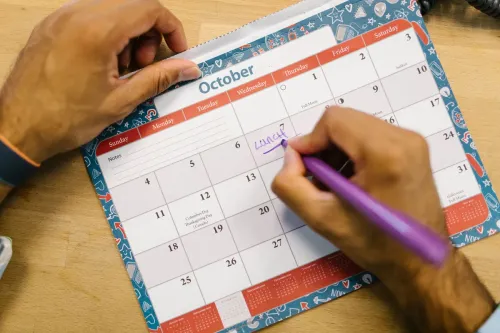
Days of the Week and Months in Tagalog
The days of the week and months in Tagalog are Spanish loanwords. Learn all 7 days and 12 months with pronunciation, plus how to say dates and 'every Monday.'

Is Tagalog Hard to Learn? An Honest Answer
Tagalog takes around 1,100 hours to reach professional proficiency. Here is what is easy, what is hard, and what to expect at 3, 6, and 12 months.

Tagalog Question Words: Ano, Sino, Saan & More
Tagalog question words like ano, sino, and saan need the right frame to work. Learn the ang-vs-pronoun rule, confusable pairs, and the ba particle with audio.