From root: amo
Usage Note
Pang-amo refers to a tool, charm, or method used to win someone over or to calm them down. In folk beliefs, it can refer to a love potion or a specific prayer.
Examples
" May pang-amo ako sa aso. "
Natural Translation
I have something to calm the dog.
Literal Translation
Has thing-to-tame I to dog.
" Nasaan ang pang-amo mo sa pusa? "
Natural Translation
Where is your item used to tame the cat?
Literal Translation
Where the tool-to-tame your to cat?
" Ayon sa kuwento ng lola ko, may dala raw na pang-amo ang manggagaway upang mapasunod ang sinumang gustuhin niya. "
Natural Translation
According to my grandmother's story, the sorcerer supposedly carried a charm to win over anyone he wanted.
Literal Translation
According to story of grandmother my, has carried reportedly charm-to-tame the sorcerer in-order win-over the whoever wanted he.
Take Tagalog with you
The full course, a 12,500-word dictionary, and flashcards that make every word stick — free to start on iOS and Android.




Tagalog builds thousands of words from a few hundred roots.
How Tagalog words workWord family
amo has 7 related forms built from the same root.
Related Words
Explore Tagalog by topic
Free guides on grammar, vocabulary, and culture to take you past single-word lookups.

Ng vs Nang in Tagalog: The Spelling Rule
Ng vs nang sound identical but spell differently. Use ng to mark nouns (of, the object), and nang for how, when, repetition, and counting time.
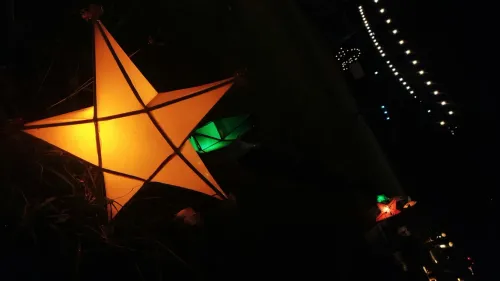
Philippine Christmas Traditions: World's Longest Holiday
Philippine Christmas traditions run four months — from Ber-month carols to Simbang Gabi dawn masses, Noche Buena feasts, and parol lanterns lighting every street.

Tagalog Numbers 1-100: Counting, Time & Money Explained
Learn Tagalog numbers 1-100 and beyond. Master both native and Spanish-derived counting systems, plus telling time, reading prices, and ordinals.
May vs Mayroon vs Meron: Have & There Is
May vs mayroon in Tagalog finally made simple: one rule decides which to use, plus how meron and wala fit the same have and there-is family.