Usage Note
Apak describes the state of being barefoot — walking without footwear. In the Philippines, walking barefoot is common inside homes (shoes are typically removed at the door) and in rural areas. The word also appears in the related verb apakin and the homonym ápak (step, footprint) where the stress falls on the first syllable.
Examples
" Apak ang mga bata sa labas. "
Natural Translation
The children are barefoot outside.
Literal Translation
Barefoot the children in outside.
" Masakit ang apák sa bato. "
Natural Translation
Stepping barefoot on stones is painful.
Literal Translation
Painful the barefoot in stone.
" Naglakad kaming apak sa mainit na buhangin habang naghahanap ng kabibe sa tabing-dagat. "
Natural Translation
We walked barefoot on the hot sand while looking for shells along the shore.
Literal Translation
Walked we barefoot in hot sand while searching of shell at shore.
Take Tagalog with you
The full course, a 12,500-word dictionary, and flashcards that make every word stick — free to start on iOS and Android.




Tagalog builds thousands of words from a few hundred roots.
How Tagalog words workRelated Words
Explore Tagalog by topic
Free guides on grammar, vocabulary, and culture to take you past single-word lookups.
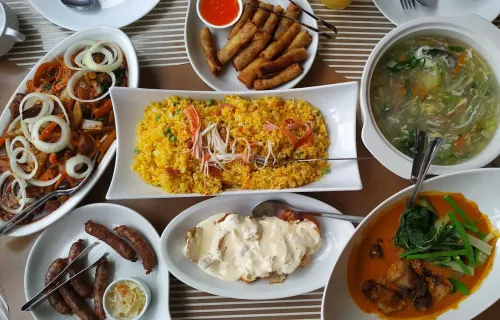
Filipino Food: 12 Essential Dishes (With Tagalog Names)
Filipino food, from adobo to halo-halo: learn the Tagalog names, pronunciations, and ingredients behind 12 dishes you'll want to try on your first trip.

Tagalog Numbers 1-100: Counting, Time & Money Explained
Learn Tagalog numbers 1-100 and beyond. Master both native and Spanish-derived counting systems, plus telling time, reading prices, and ordinals.

Na vs -ng in Tagalog: The Linker Rule Made Simple
When do you use na vs -ng in Tagalog? One simple rule, with clear examples, memory tips, and common mistakes explained for English-speaking beginners.

Tagalog Slang Guide: 20 Words You'll Hear on TikTok
Tagalog slang explained: lodi, petmalu, werpa, astig, chika and more. Decode Filipino TikTok comments, group chats, and pop culture with this practical guide.