bulaklakan
to decorate with flowers

From root: bulaklak
Conjugations
Past (Completed)
binulaklakan
bi-nu-lak-la-KAN
decorated with flowers
Present (Incomplete)
binubulaklakan
bi-nu-bu-lak-la-KAN
decorating with flowers
Future (Contemplated)
bubulaklakan
bu-bu-lak-la-KAN
will decorate with flowers
Usage Note
Bulaklakan is used when describing the act of decorating a specific area or object with flowers, often in the context of traditional Filipino festivities like Flores de Mayo or weddings. It implies the physical adornment of a space to create a celebratory atmosphere.
Examples
" Bulaklakan natin ang pinto. "
Natural Translation
Let's decorate the door with flowers.
Literal Translation
Decorate-with-flowers we the door.
" Gusto niyang bulaklakan ang mesa. "
Natural Translation
She wants to decorate the table with flowers.
Literal Translation
Want she decorate-with-flowers the table.
" Binulaklakan ng mga dalaga ang buong simbahan bago magsimula ang prusisyon tuwing Mayo. "
Natural Translation
The young women decorated the whole church with flowers before the procession began every May.
Literal Translation
Decorated-with-flowers of the maidens the whole church before begin the procession every May.
Take Tagalog with you
The full course, a 12,500-word dictionary, and flashcards that make every word stick — free to start on iOS and Android.




Tagalog builds thousands of words from a few hundred roots.
How Tagalog words workWord family
bulaklak has 6 related forms built from the same root.
Related Words
Explore Tagalog by topic
Free guides on grammar, vocabulary, and culture to take you past single-word lookups.
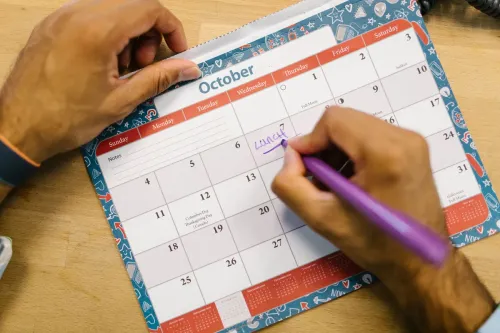
Days of the Week and Months in Tagalog
The days of the week and months in Tagalog are Spanish loanwords. Learn all 7 days and 12 months with pronunciation, plus how to say dates and 'every Monday.'

Mano Po and Filipino Etiquette: A Visitor's Guide
Mano po presses an elder's hand to your forehead as a blessing. Learn who to mano, how to lip-point, and the etiquette that wins over a Filipino family.

Filipino Family Words and Honorifics: Ate, Kuya & Tita
Filipino family words like ate, kuya, tita, tito, lolo, and lola go far beyond family — learn how Filipinos use them with strangers, plus mano po etiquette.

Tagalog Verb Conjugation: Aspects Made Simple
Tagalog verb conjugation uses aspects, not tenses. Learn the three aspects with -um- and mag- verbs, one reduplication rule, and clear example tables.