kumunyapit
kumunyápit with stress marks
to cling
From root: kunyapit
Conjugations
Past (Completed)
kumunyapit
ku-mun-YA-pit
clung
Present (Incomplete)
kumukunyapit
ku-mu-kun-YA-pit
is clinging
Future (Contemplated)
kukunyapit
ku-kun-YA-pit
will cling
Usage Note
Kumunyapit is the actor-focus infinitive of kunyapit, describing clinging or holding tightly to a surface, person, or support. Common in both literal physical contexts — a child grasping a parent, a climber gripping a rope — and figurative ones such as clinging to hope or a belief; when the thing being held is the focus, kunyapitan is used.
Examples
" Kumunyapit ang bata sa kamay ko. "
Natural Translation
The child clung to my hand.
Literal Translation
Clung the child to hand my.
" Mahilig kumunyapit ang sanggol sa kanyang ina. "
Natural Translation
The baby loves to cling to their mother.
Literal Translation
Fond to cling the baby to their mother.
" Sa kabila ng paulit-ulit na bigo, patuloy pa rin siyang kumunyapit sa pag-asang magbabago ang lahat balang araw. "
Natural Translation
Despite the repeated failures, he still keeps clinging to the hope that everything will change someday.
Literal Translation
In spite of repeated failure, continuing still he to-cling to hope that will-change the everything someday.
Take Tagalog with you
The full course, a 12,500-word dictionary, and flashcards that make every word stick — free to start on iOS and Android.




Tagalog builds thousands of words from a few hundred roots.
How Tagalog words workWord family
kunyapit has 1 related form built from the same root.
Related Words
Explore Tagalog by topic
Free guides on grammar, vocabulary, and culture to take you past single-word lookups.

Seasons in the Philippines: A Tagalog Guide
The Philippines has two seasons, not four. Learn tag-araw, tag-ulan, and taglamig, the generative tag- prefix, and the weather vocabulary to match.

Filipino Family Words and Honorifics: Ate, Kuya & Tita
Filipino family words like ate, kuya, tita, tito, lolo, and lola go far beyond family — learn how Filipinos use them with strangers, plus mano po etiquette.

Tagalog Numbers 1-100: Counting, Time & Money Explained
Learn Tagalog numbers 1-100 and beyond. Master both native and Spanish-derived counting systems, plus telling time, reading prices, and ordinals.
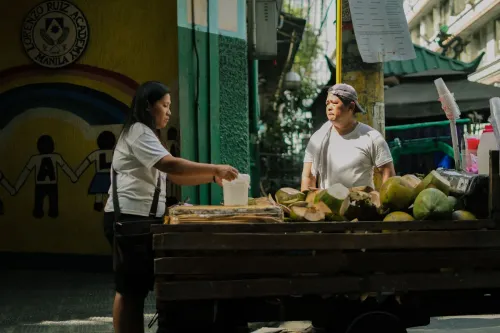
Magkano: How to Ask "How Much" in Tagalog
Magkano means how much in Tagalog. Learn to ask a price, tell it apart from ilan and gaano, sound polite with po, and haggle at the palengke.