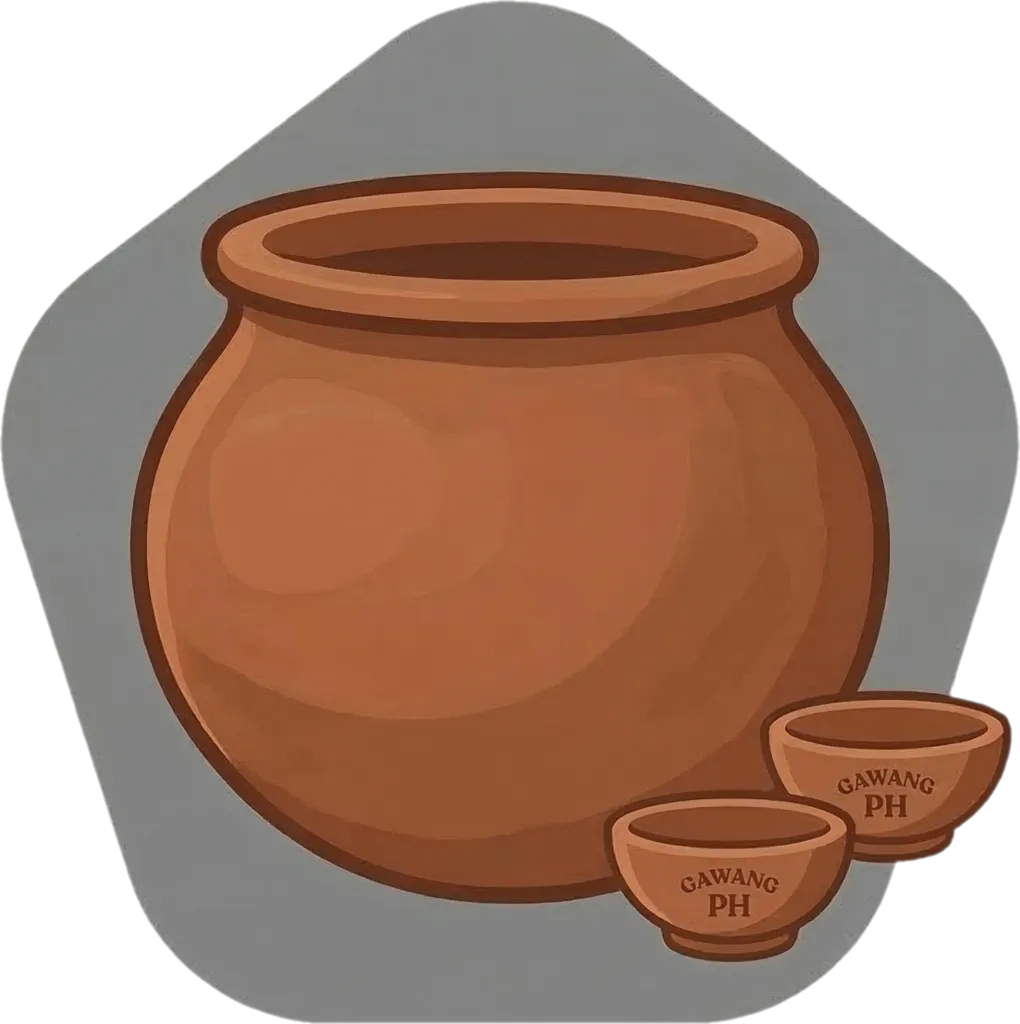
From root: luwad
Conjugations
Past (Completed)
nagluwad
nag-LU-wad
worked with clay
Present (Incomplete)
nagluluwad
nag-lu-LU-wad
working with clay
Future (Contemplated)
magluluwad
mag-lu-LU-wad
will work with clay
Usage Note
Magluwad is used when referring to the specific craft of molding or shaping clay into pottery or figures. It is a technical term mostly used in artistic or traditional contexts and is not commonly heard in everyday casual conversation.
Examples
" Marunong siyang magluwad. "
Natural Translation
She knows how to work with clay.
Literal Translation
Knowledgeable she work-with-clay.
" Natuto siyang magluwad sa paaralan. "
Natural Translation
She learned to work with clay at school.
Literal Translation
Learned he/she work with clay at school.
" Bago nagsimula ang palihan, tinuruan kami ng guro kung paano magluwad nang maayos at maingat. "
Natural Translation
Before the workshop started, the teacher taught us how to work with clay properly and carefully.
Literal Translation
Before started the workshop, taught us the teacher how to work-with-clay properly and carefully.
Take Tagalog with you
The full course, a 12,500-word dictionary, and flashcards that make every word stick — free to start on iOS and Android.




Tagalog builds thousands of words from a few hundred roots.
How Tagalog words workWord family
luwad has 2 related forms built from the same root.
Related Words
Explore Tagalog by topic
Free guides on grammar, vocabulary, and culture to take you past single-word lookups.

Tagalog Question Words: Ano, Sino, Saan & More
Tagalog question words like ano, sino, and saan need the right frame to work. Learn the ang-vs-pronoun rule, confusable pairs, and the ba particle with audio.
Po and Opo in Tagalog: Where to Put Them Right
Po and opo confuse learners — but placement follows one rule. Where po goes in a sentence, why it's opo not 'oo po', and the pronoun shift to learn.

Tagalog Verb Focus System Explained (It's Not Active vs. Passive)
The Tagalog verb focus system isn't active vs. passive. Learn actor focus, object focus, and more with clear examples that finally make it click.

Mano Po and Filipino Etiquette: A Visitor's Guide
Mano po presses an elder's hand to your forehead as a blessing. Learn who to mano, how to lip-point, and the etiquette that wins over a Filipino family.