mandala
mandalá with stress marks
haystack; circular/square deity image
Usage Note
Mandala in Philippine agricultural tradition refers to a circular pile of harvested rice stalks. The same word appears in religious and artistic contexts as a geometric sacred diagram, reflecting the word's blend of indigenous roots and pre-colonial Hindu-Buddhist influence.
Examples
" Malaki ang mandala sa bukid. "
Natural Translation
The haystack in the field is big.
Literal Translation
Big the haystack in-the field.
" Mataas ang mandala. "
Natural Translation
The haystack is high.
Literal Translation
High the haystack.
" Pagkatapos ng ani, nagtulong-tulong ang mga magsasaka sa pagbuo ng malalaking mandala ng dayami sa gitna ng bukid. "
Natural Translation
After the harvest, the farmers worked together to build large haystacks of straw in the middle of the field.
Literal Translation
After of-the harvest, helped-one-another the [mga] farmer in-the building of large [mga] haystack of straw in middle of-the field.
Take Tagalog with you
The full course, a 12,500-word dictionary, and flashcards that make every word stick — free to start on iOS and Android.




Tagalog builds thousands of words from a few hundred roots.
How Tagalog words workRelated Words
Explore Tagalog by topic
Free guides on grammar, vocabulary, and culture to take you past single-word lookups.

Tagalog Time Expressions: Past, Present & Future Guide
Tagalog has no tenses — it uses aspect. Learn time words, days of the week, clock time, and the aspect system, with vocabulary tables and cultural notes.

Tagalog Verb Conjugation: Aspects Made Simple
Tagalog verb conjugation uses aspects, not tenses. Learn the three aspects with -um- and mag- verbs, one reduplication rule, and clear example tables.
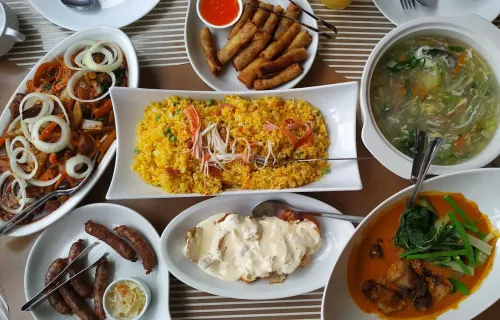
Filipino Food: 12 Essential Dishes (With Tagalog Names)
Filipino food, from adobo to halo-halo: learn the Tagalog names, pronunciations, and ingredients behind 12 dishes you'll want to try on your first trip.

Tagalog Word Order: Sentence Structure Made Simple
Why Tagalog puts the verb first, and how ang, ng, and sa markers work. A clear guide to VSO word order, forming questions, and negation.