Also means
May can also function as an existential particle meaning 'there is' or 'there are', equivalent to 'mayroon' in full form.
Usage Note
May is one of the most fundamental words in Tagalog, functioning as an existential or possessive quasi-verb. It is the short contracted form of 'mayroon' and is used before nouns. It cannot be negated; 'wala' is its negative counterpart.
Examples
" May bago akong sapatos. "
Natural Translation
I have new shoes.
Literal Translation
Have new I shoes.
" May magandang balita siya para sa ating lahat ngayon. "
Natural Translation
He/She has good news for all of us today.
Literal Translation
Has good [ng] news he/she for to-the our all today.
" Kahit may sakit siya, pumasok pa rin siya sa trabaho dahil maraming kailangang tapusin bago matapos ang linggo. "
Natural Translation
Even though he was sick, he still went to work because there was a lot to finish before the week ended.
Literal Translation
Even-though has sickness he, entered still he to work because many need-to finish before end the week.
Take Tagalog with you
The full course, a 12,500-word dictionary, and flashcards that make every word stick — free to start on iOS and Android.




Tagalog builds thousands of words from a few hundred roots.
How Tagalog words workRelated Words
Explore Tagalog by topic
Free guides on grammar, vocabulary, and culture to take you past single-word lookups.
May vs Mayroon vs Meron: Have & There Is
May vs mayroon in Tagalog finally made simple: one rule decides which to use, plus how meron and wala fit the same have and there-is family.

Tagalog Word Order: Sentence Structure Made Simple
Why Tagalog puts the verb first, and how ang, ng, and sa markers work. A clear guide to VSO word order, forming questions, and negation.

Mano Po and Filipino Etiquette: A Visitor's Guide
Mano po presses an elder's hand to your forehead as a blessing. Learn who to mano, how to lip-point, and the etiquette that wins over a Filipino family.
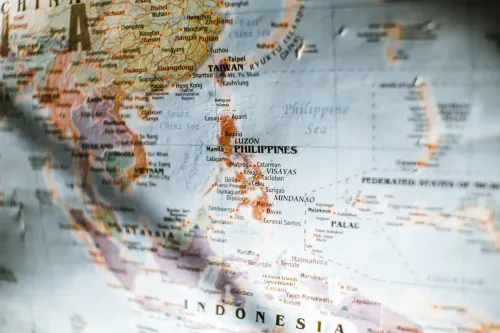
Philippines Geography for Learners: Islands & Language
Philippines geography for Tagalog learners: 7,641 islands, three island groups, and the Southern Luzon heartland where the Tagalog language was born.