meron
merón with stress marks
to have; there is
Usage Note
Meron is the spoken form of mayroon — 'to have' or 'there is'. It is what people actually say in conversation and write in messages, while mayroon is kept for formal writing. Use it on its own as an answer (Meron. — 'There is.') or before a pronoun, as in meron akong...
Examples
" Meron akong aso. "
Natural Translation
I have a dog.
Literal Translation
Have I-link dog.
" Meron ka bang barya para sa pamasahe? "
Natural Translation
Do you have change for the fare?
Literal Translation
Have you [question]-link coins for the fare?
" Meron pa kaming natirang ulam mula kagabi, kaya hindi na natin kailangang magluto ngayong tanghali. "
Natural Translation
We still have leftover food from last night, so we don't need to cook this noon.
Literal Translation
Have still we-link leftover-link dish from last-night, so not anymore we need-link to-cook this-link noon.
Take Tagalog with you
The full course, a 12,500-word dictionary, and flashcards that make every word stick — free to start on iOS and Android.


Tagalog builds thousands of words from a few hundred roots.
How Tagalog words workRelated Words
Explore Tagalog by topic
Free guides on grammar, vocabulary, and culture to take you past single-word lookups.

May vs Mayroon vs Meron: Have & There Is
May vs mayroon in Tagalog finally made simple: one rule decides which to use, plus how meron and wala fit the same have and there-is family.

Ng vs Nang in Tagalog: The Spelling Rule
Ng vs nang sound identical but spell differently. Use ng to mark nouns (of, the object), and nang for how, when, repetition, and counting time.

Tagalog Question Words: Ano, Sino, Saan & More
Tagalog question words like ano, sino, and saan need the right frame to work. Learn the ang-vs-pronoun rule, confusable pairs, and the ba particle with audio.
Days of the Week and Months in Tagalog
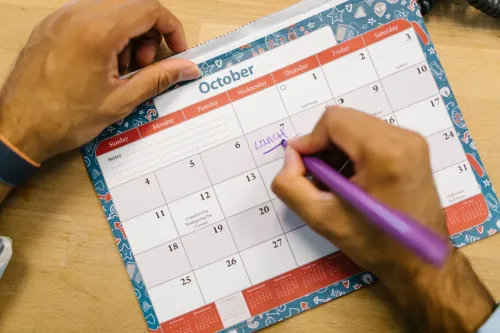
The days of the week and months in Tagalog are Spanish loanwords. Learn all 7 days and 12 months with pronunciation, plus how to say dates and 'every Monday.'