otobiyograpiya
otobiyograpíya with stress marks
autobiography
Usage Note
Otobiyograpiya is borrowed from English 'autobiography' and is used in literary and academic contexts to refer to a self-written life story. Filipino politicians, celebrities, and national heroes are common subjects of autobiographical literature, making this a recognizable term in educated discourse.
Examples
" Binabasa ko ang kanyang otobiyograpiya. "
Natural Translation
I am reading his/her autobiography.
Literal Translation
Reading I the his/her autobiography.
" Nagsusulat siya ng kanyang sariling otobiyograpiya. "
Natural Translation
He/she is writing his/her own autobiography.
Literal Translation
Writing he/she of his/her own autobiography.
" Sa kanyang otobiyograpiya ay ibinahagi ng manunulat ang mga pinakamahihirap na sandali ng kanyang buhay na hindi pa niya naikuwento kanino man. "
Natural Translation
In his/her autobiography, the writer shared the hardest moments of his/her life that he/she had never told anyone.
Literal Translation
In his/her autobiography shared by writer the plural hardest moment of his/her life that not yet he/she told anyone whatever.
Take Tagalog with you
The full course, a 12,500-word dictionary, and flashcards that make every word stick — free to start on iOS and Android.




Tagalog builds thousands of words from a few hundred roots.
How Tagalog words workRelated Words
Explore Tagalog by topic
Free guides on grammar, vocabulary, and culture to take you past single-word lookups.

Na vs -ng in Tagalog: The Linker Rule Made Simple
When do you use na vs -ng in Tagalog? One simple rule, with clear examples, memory tips, and common mistakes explained for English-speaking beginners.

Is Tagalog Hard to Learn? An Honest Answer
Tagalog takes around 1,100 hours to reach professional proficiency. Here is what is easy, what is hard, and what to expect at 3, 6, and 12 months.
Philippine Christmas Traditions: World's Longest Holiday
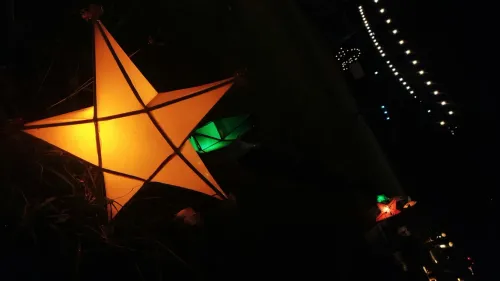
Philippine Christmas traditions run four months — from Ber-month carols to Simbang Gabi dawn masses, Noche Buena feasts, and parol lanterns lighting every street.

Tagalog Verb Conjugation: Aspects Made Simple
Tagalog verb conjugation uses aspects, not tenses. Learn the three aspects with -um- and mag- verbs, one reduplication rule, and clear example tables.