sampilungin
sampilungín with stress marks
to slap [someone] across the face
From root: sampilong
Conjugations
Past (Completed)
sinampilong
si-nam-pi-LONG
slapped across the face
Present (Incomplete)
sinasampilong
si-na-sam-pi-LONG
is being slapped across the face
Future (Contemplated)
sasampilungin
sa-sam-pi-lu-NGIN
will be slapped across the face
Usage Note
Sampilungin is the object-focus -in form of sampilong, a vivid term for a blow landing across the nose and mouth area — more specific in targeting than sampal. Informal and colorful in register, it is characteristic of dramatic storytelling about fights rather than formal or legal description, and rare outside colloquial and narrative speech.
Examples
" Huwag mong sampilungin ang bata. "
Natural Translation
Don't slap the child across the face.
Literal Translation
Don't you slap-across-face the child.
" Ayaw kong sampilungin ang bastos na bata. "
Natural Translation
I don't want to slap the rude child across the face.
Literal Translation
Dislike I to-slap-across-face the rude linker child.
" Galit man siya, hindi niya dapat sampilungin ang sinuman dahil masama ang manakit ng kapwa. "
Natural Translation
Even if he is angry, he shouldn't slap anyone across the face because hurting others is wrong.
Literal Translation
Angry though he, not he should slap-across-face the anyone because bad the to-hurt of fellow.
Take Tagalog with you
The full course, a 12,500-word dictionary, and flashcards that make every word stick — free to start on iOS and Android.




Tagalog builds thousands of words from a few hundred roots.
How Tagalog words workRelated Words
Explore Tagalog by topic
Free guides on grammar, vocabulary, and culture to take you past single-word lookups.

Tagalog Numbers 1-100: Counting, Time & Money Explained
Learn Tagalog numbers 1-100 and beyond. Master both native and Spanish-derived counting systems, plus telling time, reading prices, and ordinals.

Ang, Ng, Sa: The 3 Tagalog Case Markers Explained
Ang, ng, sa are the three Tagalog case markers every noun takes. Learn what each does, the personal forms si/ni/kay, plurals with mga, and clear examples.
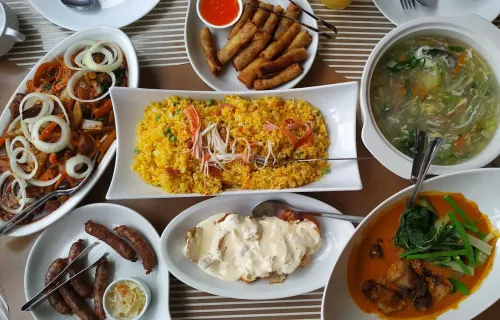
Filipino Food: 12 Essential Dishes (With Tagalog Names)
Filipino food, from adobo to halo-halo: learn the Tagalog names, pronunciations, and ingredients behind 12 dishes you'll want to try on your first trip.

Po and Opo in Tagalog: Where to Put Them Right
Po and opo confuse learners — but placement follows one rule. Where po goes in a sentence, why it's opo not 'oo po', and the pronoun shift to learn.